Is Downton Abbey Reactionary?
Janelle Pötzsch
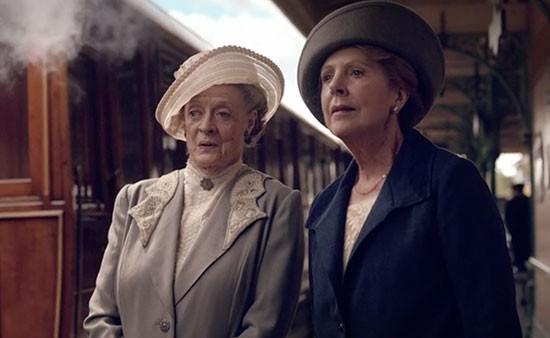
For many people, the popular British TV-series Downton Abbey (2010-2015) is a deeply conservative text which celebrates the social stratification of a bygone-era (Byrne 2015, Layne 2020, Robison 2020). Such interpretation suggests itself especially in the comparison between the Dowager Countess Violet Crawley with Isobel Crawley, mother of the unexpected heir to Downton Abbey, Matthew Crawley, from the middle class. Their catty exchanges set the stage for a comedy of manners which seems to be all about the clash of culture between the aristocracy and the middle class. But I believe those frenemies teach us an important lesson about how we can (and should) deal with difference of opinion. In turn, their situationship also sheds a new light on the supposedly dubious politics of Downton Abbey.
Clash of Cultures
Violet Crawley, mother of Robert Crawley and grandmother to Mary, Edith, and Sybil, is the eldest family member and represents “ties to the old world and the thought processes of it” (Morrow 2018: 115). She belongs to the preceding generation of the Victorians and is portrayed as someone deeply vexed by the rapid social and technological change around her. She openly admits that she “hanker[s] for a simpler world” (season 1, episode 4) and that she sometimes feels as if she “were living in an H. G. Well’s novel” (season 1, episode 7). Violet is moreover an extremely class-conscious character: when her granddaughter Edith tells the family over dinner that she’ll help a convalescing tenant by working on his farm, Violet meets Edith’s announcement with an indignant “You’re a lady and not Toad of Toad Hall” (season 2, episode 2).
Isobel Crawley on the other hand is a full-blooded progressive. She enters the stage as a busy body from industrial Manchester, who eventually spearheads dozens of social projects: She works with wounded soldiers (season 2), Russian immigrants (season 5), and even prostitutes (season 3). She does not mind rubbing shoulders with social outcasts, and neither does she fear being compromised by her contact with them (cf. the reaction of the Crawley family when they learn that Isobel has hired a former prostitute as a maid in season 3). Isobel is a do-gooder who cares little about other people’s opinions. Incidentally, her fearlessness (the dowager very likely would prefer the term ‘callousness’), comes in handy even for the Crawley family, who quickly install the widowed nurse as second chairwoman of the local hospital since Isobel is the only one in the community who dares to openly disagree with Violet (season 1, episode 2).
Already their first meeting foretells that the relation between Violet and Isobel will be a turbulent one: Violet replies to Isobel’s confiding “How shall we call each other?” with a standoffish “We can always start with Lady Grantham and Mrs. Crawley!” (season 1, episode 2). From this moment on, the two women are in a tug of war over authority and influence.
In the same episode, Isobel persuades the local doctor to perform a new method to cure a farmer from dropsy – against all odds, not to mention Violet Crawley’s bitter protest, Isobel succeeds, and the pericardial tap does indeed save the young husband’s life. Isobel’s open-mindedness and scientific curiosity are depicted as a much-needed corrective force to the settled ways of the Downton community. However, Isobel’s engagement sometimes seems over-the-top, as when she misdiagnosed the valet Mosley with erysipelas (season 1, episode 4). Only the dowager recognizes that Mosley’s rash is an allergic reaction to rue he is currently trying to get rid off in his garden. Throughout the series, the women’s juxtaposition regularly ends in a draw. This intensifies the ‘Pride and Prejudice’-situations Violet and Isobel repeatedly find themselves in, and which prevents them from recognizing their respective merits. What could turn these utterly dissimilar women into friends?
Reconciliation and recognition
Superficially, the positioning of Violet and Isobel seems like a competition over the respective merits of the upper class vs. the middle class. But there is more to their conflict. Eventually, both women develop a mutual understanding of each other, and their combined forces prove beneficial for their community. Nowhere is this more evident than in the local flower show in episode 5 of season 1: On learning that the prize for the best bloom has always been awarded to the Dowager Countess, Isobel voices her suspicion to Violet: “You may not know it, but I believe the committee feel obliged to give you the cup for the best bloom as a kind of local tradition.” Unsurprisingly, Violet dismisses Isobel’s doubts – at first.
In his famous defence of free speech in On Liberty (1859), John Stuart claims that “the interests of truth require a diversity of opinions” (Mill 58). In Downton, it’s Isobel who brings such diversity of opinions into the open. Her outspokenness makes Violet see what used to be a blind spot of hers. Previously, Violet was oblivious to the extent to which people wished to please her, the Dowager Countess. On opening the note with the name of the winner of the flower show she is meant to announce, Violet realizes that Isobel was right: Like in the past years, it’s her name on the sheet. By passing this over and pronouncing a competitor who has always been second to her as the winner instead, Violet rectifies a long-standing injustice – one which Isobel has brought to her attention. The flower show incident perfectly illustrates J.S. Mill’s claim that “the only way in which a human being can make some approach to knowing the whole of a subject, is by hearing what can be said about it by persons of every variety of opinion, and studying all modes in which it can be looked at by every character of mind” (Mill 25). In this sense, Isobel’s meddling enhances Violet’s understanding of her community.
Another defining moment of Isobel’s and Violet’s relationship is their controversy over John Pegg, a young man Isobel persuades Violet to employ as gardener. Shortly after Pegg starts working for the dowager, little things like letter openers and netsukes start disappearing. Violet suspects Pegg of stealing and therefore dismisses him. Isobel, however, is convinced that Pegg is innocent (an intuition which is proven right when Violet’s butler Sprat finds the missing netsuke in a maid’s cleaning bucket, see episode 5 of season 4).
This incident likewise seems to split the middle and working class (Isobel and John Pegg) against the aristocracy: who is considered capable of stealing, and who sides with whom in the ensuing quarrel? But just like at the flower show, Isobel’s persistence makes Violet reconsider her belief and reinstall a rehabilitated John Pegg.
These events, however, should not make us think that divergence of opinion can and should always result in persuasion, or conformity. Mill points out that divergence of opinion can increase our knowledge even if we do not reconcile. Learning about other people’s different perspectives does not imply that we should simply adapt to them. According to Mill, the very confrontation with dissent suffices because it forces us to define our position. If someone challenges a dearly held opinion of yours, you must give arguments for it. You therefore may even refine the reasons you have for cherishing your opinion and thereby become clearer yourself of why you hold it. This is why Mill argues that “[i]f the cultivation of the understanding consists in one thing more than in another, it is surely in learning the grounds of one’s own opinions” (Mill 41). Debating improves our mutual understanding because it forces us to spell out our underlying convictions. Meeting with opposition can thus have the effect that we truly engage with, and reflect on, what we believe. For this reason, Mill points out that:
However unwillingly a person who has a strong opinion may admit the possibility that his opinion may be false, he ought to be moved by the consideration that however true it may be, if it is not fully, frequently, and fearlessly discussed, it will be held as a dead dogma, not a living truth. (Mill 40).
Consider how such ‘living truth’ plays out in season 6, where the board of Downton Hospital face a merger with the Royal Yorkshire Hospital. As usual, Violet and Isobel are on different sides of the debate: Isobel welcomes the merger because it will offer local patients better treatment and make fund-raising activities easier (season 6, episode 1), whereas Violet is deeply opposed to it. This conflict smolders over several episodes, until the merger is eventually agreed upon in episode 5. Isobel accuses Violet and her only other comrade-in-arms, Doctor Clarkson, of opposing the merger for fear of their status (season 6, episode 4).
However, the seemingly class-ridden Violet surprises both viewers and the other characters on the show by expressing highly individualistic concerns over the fusion of the two hospitals: “For years, I’ve watched governments take control of our lives. And their argument is always the same. Fewer costs, greater efficiency. But the result is the same, too. Less control by the people, more control by the state. […] That is what I consider my duty to resist.” On hearing this, Isobel concedes “I do see that your argument was more honourable than I’d appreciated” (season 6, episode 4). It is only after Violet has stated the grounds of her opinion that Isobel can fully comprehend her point of view.
Family Issues
Isobel, however, is not the only one to misjudge Violet. If that were the case, their misunderstandings could indeed pass as a mere class-conflict. But that the Dowager Countess is misunderstood even by her closest family vindicates a different reading. The bafflement Violet creates among her family is nicely captured in the following exchange between Lord and Lady Grantham and their grandchildren, whom they show some souvenirs and photographs from their previous travels around the world:
Sybbie: What’s this?
Robert: That’s the Sphinx, darling. In Egypt.
Sybbie: What?
Robert: A Sphinx. [beat] A creature of secrets that she never reveals.
Cora: [in a hushed voice] Rather like Granny Violet.
(Season 6, episode 5).
Robert’s facial expression suggests he agrees with this characterization of his mother.
The younger generation likewise can’t make out Violet’s character. In season 5, Isobel receives a marriage proposal from Lord Merton. The Dowager’s reaction to this announcement makes everyone in the Crawley family suspect that Violet resents Isobel’s engagement for the increase in status it implies. When Mary meets Violet’s lack of enthusiasm over Isobel’s engagement by beseeching her “Your positions have changed. […] But you simply have to be bigger than that,” a visibly hurt Violet responds softly:
“Is that what you think of me? [Beat] That I care about her change of rank? […] If you must know, I’ve got used to having a companion. [Beat] A friend. You know, someone to talk things over with […] Isobel and I had a lot in common and [Beat] I should miss that” (season 5, episode 7).
But Mary’s misjudgement does not end here. In the same scene, she also errs when she points out to Violet that “Isobel’s always been your protégé. She looks up to you and you have kept her from harm in return.” Violet’s reply voices what has always been clear to viewers: “I don’t think Isobel has ever looked up to me.” This is precisely what makes their relation so special. In Isobel, Violet has finally found someone who is not afraid to affront her and who doesn’t let social rank get in the way. Their equal footing allows them to be(come) open and share their thoughts. When it comes to the other people at Downton, Violet is the mother, mother-in-law, grandmother, or former employer. All these positions make it difficult, if not even impossible for her to grow close with people or meet them at eye-level. It takes a character as confident and approachable as Isobel to change this.
Common Wealth
Despite their different social backgrounds and world views, Violet and Isobel prove themselves to be very much alike. Their initial confrontations are less about the respective merits of political systems and schools of thought. Rather, their story is one of convergence since the former opponents become close friends over the course of the series. Their unlikely friendship casts an interesting light on Downton Abbey’s politics and offers an insightful comment on the different political forces within a community: The friendship between Isobel and Violet seems unlikely only at a first, superficial glance. Over the course of the series, it becomes clear that both women need each other. They experience emotional and intellectual growth due to their arguments. This suggests that their quarrels are essential for their identity formation; each defines herself in opposition to the other and thereby acquires a clearer sense of self. But they also develop a mutual understanding for each other.
Moreover, the women’s juxtaposition ends in a draw since characters are depicted as fallible. They are hence alternately in need of the corrective force of her respective nemesis. And since none triumphs over the other, it remains unclear whose perspective the viewer is expected to endorse. Downton Abbey thereby illustrates that divergence of opinion is vital for a community. The ensuing contention makes it necessary to sharpen one’s own position and argumentation. Moreover, discussing one’s differences ideally brings about acknowledgment of the opposite opinion – one recognizes the motivations as well as the strength of one’s opponent. Ideally, we thereby develop respect for our political opponent.
Besides, the quarrels between Isobel and Violet carry home the message that we should focus on what we have in common rather than on what sets us apart. Both women want the best for their community, but because of their differences in class and world-view, the issues they consider necessary to fix naturally differ. This, however, isn’t necessarily a bad thing. By including both perspectives, the women acquire a broader view of the world around them and can act more effectively.
The unlikely friendship between the Dowager Countess Violet Crawley and middle-class Isobel Crawley therefore offers a lesson in tolerance. Since both their viewpoints are being presented as well-founded, the two women are portrayed as complementary social forces which are essential for each other’s intellectual and emotional development. Downton Abbey is hence anything but reactionary.
Janelle Pötzsch, PhD, is a philosopher who has specialized in business ethics and political philosophy. She works at the Centre for Teaching and Learning of Ruhr-Universität Bochum, Germany. As a member of their Writing Center, she assists students in their writing processes.
References
Byrne, Katherine (2015). New Developments in Heritage. The Recent Dark Side of Downton ‘Downer’ Abbey. In: James Leggott & Julie Anne Taddeo (Eds.), Upstairs and Downstairs. British Costume Drama Television from The Forsyte Saga to Downton Abbey (pp. 177-189). Roman & Littlefield.
Layne, Bethany (2020). “’Welcome to a New Era’? Downton Abbey in 2019.” Journal of Popular Film and Television, 48(2): 77-89. 10.1080/01956051.2019.1708249
Mill, John Stuart (2008). On Liberty and Other Essays. Ed. J. Gray (pp. 5-128). Oxford: Oxford University Press.
Morrow, Joy E. (2018). Wearing the Trousers: ‘Female’ Voices in ‘Male’ Spaces. In: Scott F. Stoddard (Ed.), Exploring Downton Abbey. Critical Essays (pp. 114-126). NC: McFarland Press.
Robison, Lori (2020). “Domesticating desire: Fantasy and social change in Downton Abbey and Upstairs, Downstairs.” Journal of Popular Television, 8(2): 217–236, https://doi.org/10.1386/jptv_00019_1


