Rejecting the Closed Loop
Silo, Camus, and the Goldilocks Paradox
Edwardo Pérez
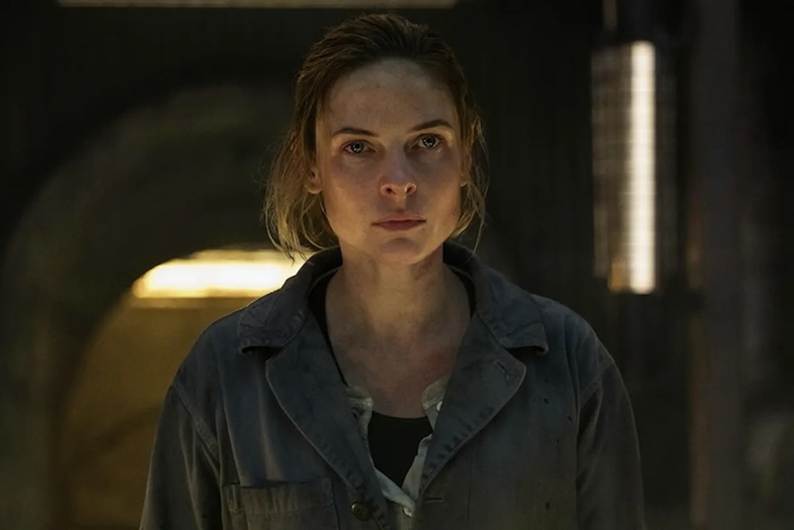
“We have to take out Silo 1.” That’s the last line Rebecca Ferguson’s Juliette says in Apple TV’s final episode (“Troy”) of Silo’s third season. While this created a nice cliffhanger, setting up next year’s fourth and final season, it is a line that has stayed with me since the third season ended.
Initially, I was intrigued by the anticipation of seeing Juliette find a way to dismantle the Silo’s oppressive system. With Andor also still on my mind, I immediately saw Juliette’s conclusion as a rallying cry against totalitarianism—especially in an Arendtian sense, with Juliette finding a way to reclaim her unique, individual (and exceedingly stubborn) self, fulfilling Hannah Arendt’s prescription for stopping (or at least providing an impediment to) the creation of living corpses.
After all, totalitarian regimes want total domination, and in Silo, Silo 1 clearly dominates the other fifty Silos—in a way that mirrors Jeremy Bentham’s Panopticon, with Silo 1 observing everything that happens in every Silo, especially in Juliette’s Silo 18 (which is where the series largely takes place).
The difference for Silo is that Silo 1 communicates with one chosen person in each of the other Silos via an AI screen referred to in the show as “the algorithm” or “the voice”—and given the current debate on AI, this is a foreboding and prescient aspect of Silo’s narrative. What’s significant is that this chosen person (Bernard in the first two seasons; Camille in season three) carries out whatever orders the voice dictates to keep the Silo’s social structure balanced—which often includes murder, manipulation, and the occasional erasure of memory.
Yet, as I kept thinking about season three’s ending and what it means for the larger narrative, I came to another realization. All fifty Silos aren’t just shelters ordered from Amazon and dug into the ground to wait out a storm, they’re massive cylindrical structures with one hundred and forty-four levels, each about forty feet tall, making the silo more than a mile deep—and with no elevators or lifts (only a spiral staircase) it takes the better part of a day to go from top to bottom.
There are living quarters, and levels for farming, supplies, mechanical, engineering, tech, medical, judicial, and law enforcement. So, the Silo isn’t a city, it’s a civilization, with a multicultural and multiethnic infrastructure of people.
In other words, the Silos are Goldilocks Zones, designed as miniature worlds, each capable of comfortably sustaining ten thousand people through meticulous control over the environment, the social hierarchy, reproduction, and the overall structure of society. As oppressive as the Silos might be, given all the measures of control, they function as compact Goldilocks Zones because they provide an environment that is “just right” for life to survive underground—since, in the show’s premise, the outside world is not habitable.
As we learn in the third season through flashbacks, trillionaire Per Stenson (played by Colin Hanks) built the Silos precisely to save a portion of humanity from the threat of nuclear war (albeit a select group of people chosen for some still unknown and possibly nefarious purpose). And the Silos were designed to sustain life for at least five hundred years. In the show’s timeline, it’s been about three hundred years so far.
It’s also worth noting that the Silos don’t just function as Goldilocks Zones, they also function as both a self-sustaining and self-annihilating environment, blending James Lovelock’s Gaia Hypothesis and Peter Ward’s Medea Hypothesis, which view Earth as either a living organism that sustains life (Gaia) or a complex structure that seeks to destroy life (Medea).
Because as self-sustaining as the Silos were designed to be, with people bred as replacements (sometimes called “Shadows” when they are assigned crucial roles), and a set of laws designed to anticipate most scenarios so that equilibrium can be maintained, the Silos are also built with various failsafe procedures, allowing Silo 1 to kill every inhabitant of a Silo if this is deemed necessary—and in a third-season flashback we see Silo 1 kill nearly ten thousand inhabitants of Silo 17, which clearly qualifies as self-annihilation.
Of course, it would be a fair criticism to say that designing a human-made Silo is categorically different from searching for a star system with habitable planets, or from the nature of our Goldilocks planet Earth, which has evolved over four billion years. Yet, the Silos aren’t just bunkers, they’re closed loop systems that operate according to the same environmental pressures as Goldilocks worlds.
In my view, the microcosmic nature of the Silos mirrors the macrocosmic nature of a Goldilocks Zone—and, regardless of whether we blend Gaia and Medea or argue for one over the other as an explanation for how life exists on Earth, the eventual outcome is the same: extinction is axiomatic.
Thus, when we analyze a Silo or a planet as a Goldilocks Zone, the result is the same: a closed loop environment that maintains balance through the creation and annihilation of life. That’s the trap of a Goldilocks Zone. It seems “just right” because it is, it contains the precise conditions for life to be able to survive. But because it is built as a closed loop, the “just right” conditions also create the circumstances for the extinction of life.
As such, the Goldilocks Zone becomes a Goldilocks Paradox: Humans need a planet with conditions that are “just right” to sustain life, but a “just right” planet also contains the predetermined conditions for our extinction. And these conditions exist as part of the planet’s nature—they’re built into the matrix, if you will. Yet, as a failsafe, extinction is also the eventual outcome of the planet’s solar system. Because no star shines forever.
Of course, no matter how well designed a Goldilocks Zone habitat might be—whether it is a Silo or a planet—human curiosity and awareness will inevitably lead some of us to question our existence by asking: Why are we here? Where did we come from? Who created this world? And why is existence so absurd?
In The Myth of Sisyphus, Albert Camus describes the moment of clarity that many of us experience when we realize the absurdity of existence as “that odd state of the soul in which the void becomes eloquent, in which the chain of daily gestures is broken, in which the heart vainly seeks the link that will connect it again” (Myth 12). For Camus, this is “the first sign of absurdity” (Myth 12). And as he adds, “one day the ‘why’ arises and everything begins in that weariness tinged with amazement” (Myth 13).
This awakening (or existential crisis) happens to many characters in Silo, not just because the environment of the Silo itself is absurd but because the absurdity begs the question “why?” Why was the Silo built? Why is the outside uninhabitable? Why must everyone in the Silo adhere to the rules of The Pact? Why must the algorithm voice be listened to? And so on.
For example, in the first season we see a character named Lukas sitting in one of the cafeterias, gazing out the Silo’s viewing screen—which constantly displays the same image of a barren landscape with a leafless, dead tree. Lukas is watching the screen at night, looking at the stars, which he shows to Juliette. Consider the scene from Season 1, Episode 5 “The Janitor’s Boy”:
Lukas: So, when it’s clear at night, there are these lights in the sky.
Juliette: Hmmm. What are they?
Lukas: I have no idea. But I’ve been watching them long enough to see these patterns. They repeat, like they’re, uh, like they’re traveling in this big circle. Here. You see it?
Juliette: I see a “W.” Never noticed that before.
Lukas: Yeah, well, now you have. I’ll just add it to the list of things we don’t know anything about.
As humans, we have an innate curiosity, don’t we? We want to know how things work, why things are, and how things came to be, especially when we see something we don’t understand, like stars twinkling at night. Yet, in Silo, this curiosity is curbed. Knowledge, information, and history are strictly controlled. Anything found that might give a hint about the outside world is confiscated and branded as an illegal “relic”—and anyone caught with a relic is punished.
So, the Silos function as both a physical prison keeping populations contained within a closed loop, as well as intellectual prisons, keeping knowledge controlled. This functions as a different sort of closed loop, a control measure designed to maintain a homeostatic environment. Thus, we confront the absurdity, the list of things we don’t know about, as Lukas describes. For Camus, this leads us to a choice between two options.
As Camus explains it, asking why “awakens consciousness and provokes what follows,” and what follows is “the gradual return into the chain or it is the definitive awakening. At the end of the awakening comes, in time, the consequence: suicide or recovery” (Myth 13).
Of course, for Camus, recovery means accepting the absurdity, because in Camus’s view, there is no escape from the absurdity. Humans are mortal and life eventually leads to death. So, we either choose death, or we live our lives fully aware of the absurdity of our existence. And in Camus’s description, the world isn’t just absurd, it’s also not reasonable. As Camus explains:
“But what is absurd is the confrontation of this irrational and the wild longing for clarity whose call echoes in the human heart. The absurd depends as much on man as on the world. For the moment it is all that links them together. It binds them one to the other as only hatred can weld two creatures together. This is all I can discern clearly in this measureless universe where my adventure takes place” (Myth 21).
What’s significant in Camus’s view is that he sees the absurd as an inescapable relationship between human consciousness and an indifferent universe. That’s why there are only two choices and he might be right. Yet, his view is shaped by the Goldilocks world he lives in. How could it be otherwise?
As a Goldilocks world, Earth represents the only reality any of us can ever know, unless we leave—not for another Goldilocks world, but for another type of existence, one we can’t imagine or know until we encounter it. If that happens, then everything changes.
And if Juliette manages to take out Silo 1, then change is exactly what will happen for everyone who survives. They will encounter another type of existence, one they don’t know, one they can’t imagine, one they haven’t planned for or designed. And if this does indeed happen, it resonates with another choice Camus offered in his essay The Rebel.
As Camus explains: “Awareness, no matter how confused it may be, develops from every act of rebellion: the sudden, dazzling perception that there is something in man with which he can identify himself, even if only for a moment” (Rebel 14). Camus likens man to a slave forced to obey orders without reaction or contemplation, patiently accepting every demand without protest.
Yet, when patience becomes impatience, Camus suggests that “a reaction begins which can extend to everything that he previously accepted, and which is almost always retroactive. The very moment a slave refuses to obey the humiliating orders of his master, he simultaneously rejects the condition of slavery. The act of rebellion carries him far beyond the point he had reached simply by refusing” (Rebel 14).
This isn’t a choice of escape. It’s a choice of rebellion, or what I call rejection—of the absurdity, and of the Goldilocks framework that created the absurdity in the first place. It’s the choice many characters in Silo make in various ways—from small acts of defiance to actual rebellion (which is what happened in season two) to Juliette declaring war on Silo 1.
Consider the following dialogue between Juliette and Bernard, which takes place just before Bernard is sent outside of the Silo to die in Season 3, Episode 9, titled “Farewell”:
Bernard: What choice do we have?
Juliette: I don’t …
Bernard: The most important thing I can leave you with is this: that voice in the wall … I always thought it was a machine. An entity of some kind. A higher intelligence. It’s not. Somewhere in Silo 1 is a person. Flesh and blood. No different or better than you or me. A person deciding our fates. Turns out, after all this, the wizard is nothing more than a man behind a curtain. And if that man were here in this room right now, I’d kill him with my bare hands. But I won’t get that chance. But you can stop them Juliette. You are the one their numbers missed. I know you don’t want to be a leader, so you don’t see this, but you are more than a disrupter. You are a unifier. Your team proves that. They believe in you and I believe in you. All of you. And there’s one last thing on my mind. All the questions I won’t see answered. They all come down to just one question.
Of course, the question Bernard implies is “why?” Yet his entire monologue doesn’t just serve as motivation for Juliette to eventually decide to take out Silo 1, it also reveals why rejection is perhaps the most prudent choice that can be made once awareness happens.
Bernard believed the voice in the wall (the algorithm) was a machine and he operated under this belief for years, performing various morally questionable actions for the good of the Silo precisely because he thought the voice was a superior intelligence, an infallible machine that guaranteed certainty. But when he realized it wasn’t, his reality was reframed.
Following Camus, Bernard isn’t just aware, he’s pitted against the absurdity of the voice, perhaps even in hatred. Thus, Bernard chooses rejection rather than obedience or suicide—because his exile from the Silo in season three was not his choice, it was a choice the voice forced Camille to make.
If we consider Bernard’s monologue as being analogous to our experience with our Goldilocks Earth and the absurdity recognized by Camus, perhaps we can ask whether the laws governing our existence are truly unalterable.
If we choose to reject our reality, does this solve the Goldilocks paradox? Does it allow us to break free from the absurdity—not to search for another Goldilocks reality, but to find another type of reality beyond the illusory comfort and beyond the predetermined fate of the Goldilocks Zone?
Extending this further, does rejection render the Gaia Hypothesis and the Medea Hypothesis irrelevant—because why should it matter whether a closed loop Goldilocks world is self-sustaining or self-annihilating (or a bit of both) if both theories lead to extinction?
Whatever the answers might be, perhaps they all begin with Juliette’s conclusion: “We have to take out Silo 1.” Once that’s accomplished and we’re out of the loop, we might still face extinction in another form, but at least it’ll be on our terms—not as a suicide or a recovery, but as a rejection of the prison that has defined and predetermined our existence as living corpses.
Like Lukas, Juliette, and Bernard, we don’t know what we don’t know. But maybe, if we take out Silo 1, we’ll find out that the world outside the loop isn’t what we think it might be.
In the end, predetermined extinction isn’t a moral failure of mother nature or a structural dead-end of the laws governing nature. It’s a wake-up call to the beings trapped inside the closed loop whose consciousness demands meaning.
Bio: A rebel at heart, Edwardo Pérez is secretly a member of Silo 18’s underground group known as The Flamekeepers, charged with keeping the memory of the “Before Times” alive through the preservation of truth—most notably by crafting philosophically penetrating essays, speculative stories that explore the absurd, and a collection of Star Wars memorabilia, which function as “relics” that can counter the effects of Silo 1’s memory-altering methods.
References
Arendt, Hannah. The Origins of Totalitarianism. Mariner Classics. 1968.
Camus, Albert. The Myth of Sisyphus and other essays. Alfred A. Knopf., Inc. 1955.
Camus, Albert. The Rebel: An essay on man in revolt. Vintage International, 1991.
Yost, Graham, creator. Silo. Seasons 1-3. Performances by Rebecca Ferguson, Tim Robbins, and Common, Apple TV+, 2023-present.


