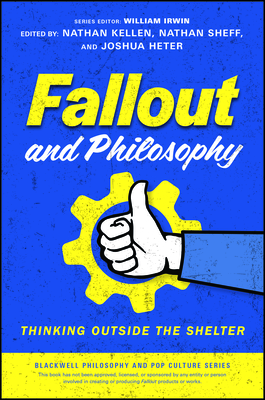
The essay below originally appears as Chapter 9 of Fallout and Philosophy, edited by Nathan Kellen, Nathan Sheff, and Joshua Heter.
Locked In: The Fallout of Liberal Ideals in Vault 33
John P. Irish
We are bonded, not just as neighbors, but by a shared duty. To keep the candle of civilization lit.
-Overseer MacLean
You look out at this wasteland, looks like chaos. But there’s always somebody behind the wheel.
-The Ghoul
Vault 33, one of the central settings in the Amazon Fallout series, is introduced as a functioning subterranean society preserved from the devastation of nuclear war. Its residents live in a carefully maintained environment, guided by communal norms, regular elections, and a visible emphasis on cooperation and order. Overseers are selected through a public vote, and a citizen council regularly convenes to discuss matters of shared concern, including leadership transitions and responses to external threats. From its food production systems to its education practices, Vault
33 operates with a high degree of internal stability and procedural formality. To its inhabitants, the vault provides continuity-a controlled environment where human civilization can survive while the outside world, the wasteland, remains hostile and chaotic. With its emphasis on democratic participation, social harmony, and civic order, Vault 33 reflects many of the aspirations commonly associated with Enlightenment rationalism and liberal political thought-particularly those of one of its chief architects, the philosopher John Locke (1632-1704). In this context, “liberal political thought” refers to the Enlightenment tradition (roughly 1680s-1820s), emphasizing individual rights, consent of the governed, constitutional limits on power, and the rule of law.
The Original Overseer
Locke emerged from the religious and political turbulence of seventeenth century England as one of the most influential thinkers of the Enlightenment. Raised by a Puritan father who fought for Parliament against the monarchy during the English Civil War, Locke was educated at Westminster and
Oxford, where he developed a lifelong interest in science, medicine, and political philosophy. His early exposure to religious disputes and civil unrest shaped his belief in tolerance, empiricism, and reasoned debate. In the 1660s, Locke formed a close partnership with the Earl of Shaftesbury, serving as his personal physician and political adviser. This alliance exposed Locke to the practical realities of power and revolution, especially during the Exclusion Crisis and the Rye House Plot. Forced into exile in Holland, Locke returned to England after the Glorious Revolution of 1688 and soon published his two most influential works: An Essay Concerning Human Understanding and Two Treatises of Government, both of which helped shape modern views on knowledge, liberty, governance, and civil society, positioning Locke as a cornerstone of Enlightenment liberalism.
At the core of Locke’s political philosophy is the belief that all individuals are by nature free, equal, and rational. In Two Treatises of Government, he argues that humans possess natural rights to life, liberty, and property even before forming any government. Political society arises, not through divine right or coercion, but through mutual consent: individuals agree to form a civil community in order to better preserve their rights, secure peace, and establish impartial laws. For Locke, legitimate government depends entirely on this consent and must act according to the will of the majority for the public good. Importantly, Locke insists that citizens retain the right to resist or overthrow any authority that violates their foundational trust. These principles-consent, equality, the rule of law, and the preservation of rights-form the ideological backbone of modern liberal democracy.[1] In Fallout, Vault 33 appears to exemplify many of these Lockean ideals. However, as the narrative unfolds, it becomes clear that these principles have been subtly removed, transforming the vault from a sanctuary of civil society into a controlled experiment in authoritarian design.
“We the Vault Dwellers”: Elected and Equal (On Paper)
Vault 33, as depicted in the Fallout Amazon series, initially presents itself as a model of post-apocalyptic order-a carefully sustained micro-society where peace, cooperation, and civic virtue prevail beneath the ruins of the world above. Its systems are orderly, and its leadership, at least ostensibly, accountable to its citizens. In contrast to the lawless wasteland, the vault represents stability, reason, and shared purpose-qualities that seem to echo the liberal political ideals of the Enlightenment, particularly those articulated by Locke. With its structured elections, public forums, and con cern for the common good, Vault 33 gives the impression of a society built upon the foundational principles of equality, consent, the rule of law, and the preservation of rights.
Locke begins his political theory with the premise that all individuals are naturally equal, “wherein all the Power and Jurisdiction is reciprocal, no one having more than another.”[2] Vault 33 reflects this vision of mutual standing through its social and political structures. There are no visible class distinctions, no ruling elite or caste system. Overseers are elected by the community, and policy decisions are discussed in open meetings where all citizens are welcome to speak and be heard. This structure is dramatized in moments of crisis, such as when Lucy Maclean proposes a rescue plan following the abduction of her father, Overseer Hank Maclean, and again when the vault council convenes to decide the fate of captured raiders from Vault 32. Rather than relying on executive decree or hierarchical command, the community turns to open deliberation-a process that reinforces the impression that power in Vault 33 is shared equally among its members.
For Locke, equality is inseparable from the principle of consent. Legitimate government, he argues, arises only when individuals willingly enter into political society, and “no one can be subjected to the Political Power of another, without his own Consent.”[3] Vault 33 reinforces this ideal through its most ceremonious civic ritual: Election Day. After the loss of Overseer Maclean, a new election is held between three candidates: Betty Pearson, Reg McPhee, and Woody Thomas-amid carefully staged patriotic imagery. Vault residents see images of a sewn flag in a scene evocative of Betsy Ross, campaign posters promote civic identity, and songs like “The Battle Hymn of the Republic” echo through the halls. The election itself becomes a reaffirmation of collective agency and shared governance. While the inner workings of vault politics remain somewhat opaque, the tone of civic life suggests that the residents believe their voices matter-that their leaders derive authority from the consent of the governed. The political culture affirms the idea that the vault is not ruled but chosen.
Casseroles and Compliance in Vault 33
This view of the vault is further supported by what appears to be the rule of law. For Locke, the transition from the state of nature to political society requires the formation of a collective will: individuals “have thereby made that Community one Body, with a Power to Act as one Body, which is only by the will and determination of the majority.”[4] Vault 33 operates under this logic. In both major crises-the disappearance of the Overseer and the arrival of the raiders-the community does not devolve into panic or despotism. Citizens convene, debate, and arrive at conclusions together. The council meetings function as scenes of rational deliberation, reinforcing the notion that law in Vault 33 is not arbitrary but participatory. It is not enforced through coercion, but through consensus, echoing Locke’s belief that just law arises from shared agreement, not imposition.
The purpose of this civil order, according to Locke, is the preservation of what he broadly defines as “property, “a term encompassing life, liberty, and material well-being. “The great and chief end therefore, of Men uniting into Commonwealths, and putting themselves under Government,” he writes, “is the Preservation of their Property,”[5] and such government must be directed “to no other end, but the Peace, Safety, and public good of the People.”[6] Vault 33, sealed off from the irradiated wasteland, appears to fulfill Locke’s vision of civil society as a protective institution. It offers its residents consistent food, shelter, education, and community-the basic conditions necessary for peace and preservation. Daily life is stable, safe, and routine. Lucy’s apartment in the first episode is especially striking. Decorated with soft pastels, clean lines, and mid-century furnishings, it evokes a sanitized, idealized version of 1950s white, middle-class domesticity. “Isn’t it great?” she says. “Every big moment of our lives is gonna happen right here.” The space, like the society around it, is designed to feel safe, familiar, and frozen in time-a carefully curated illusion of stability and happiness, where efficient but unobtrusive appliances and bright, modest rooms evoke a world of normalcy, simplicity, and calm. “We have everything, with the hand-me-downs; an icebox, a blender.” Everything from the communal dining hall to the school spaces reinforces a sense of secure continuity, as if civilization had been paused just before modern anxieties took hold.
This aesthetic is not incidental; it is part of Vault-Tec’s broader ideological project. By reconstructing a culture frozen in the imagined postwar optimism of the American 1950s, Vault 33 presents itself as both morally stable and socially coherent. It mimics the Lockean promise that a well-ordered society can secure not only life and liberty but also a harmonious domestic sphere where individuals flourish free from fear. Residents of Vault 33 are, in this sense, not simply protected from violence-they are shielded from change, dissonance, and disruption. The world outside may be chaotic and fragmented, but inside the vault life follows a script of order and predictability. It is, at least in form, a rational society-not one that seeks to dominate its citizens, but one that claims to sustain and preserve them.
This dedication to peace and the public good is exemplified in the scene where the council discusses how to handle the captured Vault 32 raiders. While one member, Norm Maclean, suggests execution, the others react with dismay, reaffirming the vault’s rejection of cruelty and its belief in rehabilitation over retribution. What follows is an almost comic but deeply revealing debate about reintegration: one resident proposes teaching the raiders Shakespeare to awaken empathy; another suggests grounding them first in moral philosophy, beginning with Immanuel Kant (1724-1804)[7] and John Stuart Mill (1806-1873);[8] yet another recommends starting with math and calculus to instill logical reasoning. Absurd though it may appear, this moment encapsulates the Enlightenment dream, the belief that humanity can be elevated through reason, education, and ethical dialogue. Vault 33, at least on the surface, represents Locke’s commonwealth not only as a system of protection but as a moral project: a society dedicated to the cultivation of rational, responsible citizens.
Taken together, the structures, rituals, and civic norms of Vault 33 suggest a community built upon the very ideals that Locke believed necessary for a just society. Its practices of open deliberation, electoral participation, legal consensus, and mutual protection all work in concert to construct the image of a functioning liberal democracy-one that has survived the apocalypse intact. At least for a time, Vault 33 appears to fulfill the Enlightenment promise: that reason, equality, and consent can triumph over violence and chaos, even in a lead-lined world.
Lead-Lined Liberalism: Equality, Now with Extra Supervision
If Vault 33 appears to reflect the political ideals of Locke on the surface, that illusion quickly collapses under scrutiny. What seems to be a democratic society governed by consent, equality, and law is in fact a carefully engineered facade-one that distorts Locke’s core principles while preserving their rhetorical trappings. Vault-Tee’s system does not fulfill the liberal promise of government by the people; instead, it perverts Enlightenment ideals by transforming them into instruments of surveillance and control. Equality, participation, and deliberation are not emancipatory here-they are mechanisms of compliance within an ongoing human experiment.
Locke insists that political society begins with equality: a “State also of Equality, wherein all the Power and Jurisdiction is reciprocal, no one having more than another.”[9] But in Vault 33, this equality is only structural in appearance. The Vault lacks a visible aristocracy, but power is far from reciprocal. Vault-Tee maintains ultimate authority, unseen and unaccountable, orchestrating the system from behind the curtain. The election of Betty Pearson as Overseer-a Vault-Tee administrator promoted under the guise of civic trust-initially seems like a genuine expression of communal will. However, when Norm Maclean gains access to Vault 32’s internal database, he discovers the truth: all overseer elections are rigged. The winning candidate in each case originates from Vault 31, and the results are manipulated to create the illusion of popular choice.
Norm’s investigation reveals something darker still: Vault 31 houses cryogenically preserved Vault-Tee bureaucrats, prewar technocrats strategically reinserted into positions of leadership in Vaults 32 and 33. This hidden class of “leaders” ensures ideological continuity and administrative control, while residents below believe they live under a self-governing social contract. The myth of shared authority collapses. Norm ultimately learns that even his father, Hank Maclean, was complicit in concealing these truths, participating in the cover-up and submission to Vault-Tee’s broader aims. Vault 33’s residents believe they are free citizens in a democratic community, but their options are bound by an invisible hierarchy. Power is not shared but simulated, distributed only insofar as it reinforces the parameters of an experiment. Locke’s principle of mutual jurisdiction is thus entirely undermined: the vault is not a commonwealth but a lab.
This illusion of equality is inseparable from a corresponding illusion of consent. “No one can be put out of this Estate, and subjected to the Political Power of another, without his own Consent,”[10] Locke writes-making informed agreement the bedrock of a legitimate political society. Yet, Vault 33’s residents are unaware of the conditions under which they live. They have not agreed to be test subjects; they do not know the nature of the larger system to which they belong. Consent here is a carefully staged performance, manufactured through omission, ignorance, and ritualized symbolism. The Election Day pageantry-with campaign posters, patriotic music, and communal flag sewing-fosters the feeling of legitimacy while disguising the reality that outcomes are already determined. Vault-Tee has preserved the form of Lockean governance only to drain it of content, using ceremony to obscure coercion.
Freedom by Design: Press 1 for Consent, 2 for Compliance
Locke views law as a rational mechanism through which free individuals voluntarily bind themselves to ensure mutual protection. “The only way whereby any one devests himself of his Natural Liberty … is by agreeing with other Men to join and unite into a Community … in a secure Enjoyment of their Properties.”[11] Vault 33 appears to function under this logic: residents live by shared rules, deliberate through councils, and resolve crises collectively. But this rule of law, like the elections, is structurally compromised. Norm’s discovery of manipulated records is matched by a deeper realization: the laws, councils, and rituals that guide vault life are not created by the people, for the people-they are imposed from above as part of a controlled social simulation.
Each vault group is operated by a different corporation, which is allowed to conduct its own experiment. Vault-Tee has engineered Vaults 31, 32, and 33 as behavioral studies, but they are not a true community. The council’s public debates-such as those concerning the captured raiders from Vault 32-may appear democratic, but the terms of discussion are carefully constrained. Outcomes are accepted not because they are freely chosen, but because they have been pre-shaped within a narrative that privileges order, predictability, and data collection. In this context, law ceases to be a covenant of mutual respect. It becomes a tool of manipulation, cloaked in language that evokes the social contract while operating entirely outside its ethical structure.
This manipulation extends even to Locke’s ultimate justification for civil society: the preservation of life and property. “Men … have a right to their Preservation, and consequently to Meat and Drink, and such other things, as Nature affords for their Subsistence.”[12] In Vault 33, these basic rights are conditional and provisional. Every aspect of daily life in Vault 33- food rations, education, reproductive roles, and family structures-is subject to institutional oversight and reconfiguration based on experimental needs. The right to preservation, which Locke describes as foundational to civil society, is no longer treated as an entitlement but rather as a reward for compliance.
One striking example is the regulation of relationships and reproduction. To ensure population growth, the vault organizes arranged marriages under the guise of community stability. Lucy’s own experience with this system is revealing: her “application” for marriage is framed as a free choice, but it is carefully manipulated to appear consensual while functioning as a mechanism of social control. This practice, staged with the aesthetic trappings of 1950s-style order and family values, reinforces the illusion of a benevolent, rational society while concealing the deeper logic of behavioral engineering. In this framework, life is preserved only to the extent that it generates useful outcomes for Vault-Tee’s long-term study. Vault-Tee does not value individuals for their judgment or dignity, only for how they serve the experiment. Locke’s vision of civil society as a safeguard for human flourishing collapses under the weight of this manipulation.
This collapse is not merely theoretical; it is vividly dramatized in key moments that expose the full extent of Vault-Tee’s betrayal of Enlightenment ideals. Two scenes in particular illustrate how the form of rational governance is preserved while its moral core is undermined. In the very first episode, after the infiltration of Vault 33 by the raiders of Vault 32, the bodies of the dead are dragged into a room marked “Compost.” On a practical level, this could be interpreted as a utilitarian solution in a closed ecosystem-efficient, necessary, and aligned with sustainability. Yet the visual framing and tonal cues suggest something colder and more cynical: the reduction of human life to material input, a quiet but chilling echo of Soylent Green-style disposability.[13] What might be reasonable in context becomes morally unsettling in presentation, blurring the line between pragmatism and dehumanization.
Later, in the eighth episode, “The Beginning,” any lingering ambiguity disappears. Cooper Howard overhears a secret meeting between Vault-Tee and executives from RobCo, West-Tek, Big MT, and others, in which his wife Barb proposes that Vault-Tee initiate the nuclear war themselves in order to ensure the success of the vault experiments. Cooper’s horror reflects the viewer’s: the apocalypse was not merely survived by Vault-Tec; it was orchestrated by them. The world was not destroyed despite their best efforts to preserve humanity, but because of their desire to control its reconstruction. The civil society Locke imagines as a bulwark against chaos has been wholly inverted. Vault-Tee has taken the outward form of Enlightenment ideals and filled it with authoritarian design, preserving structure while erasing moral intent.
Vault 33 thus reveals a chilling irony: Enlightenment liberalism, stripped of transparency and ethical grounding, can be repurposed to sustain authoritarian control under the guise of rational governance. The form of Locke’s social contract remains-elections, councils, law, and security but the spirit is absent. Consent becomes choreography, equality becomes illusion, and law becomes scripted behavior. What appears to be a liberal dream is, in truth, a philosophical parody: an experiment in freedom that offers none.
Fallout from the Enlightenment
Vault 33 offers a compelling case study in political philosophy disguised as science fiction. At first glance, the vault appears to realize John Locke’s Enlightenment vision of civil society: a community founded on equality, consent, law, and the preservation of individual rights. Its elected leadership, participatory governance, and shared commitment to public order seem to embody the principles outlined in Locke’s Two Treatises of Government. But beneath this surface lies a calculated inversion. Vault-Tee has reconstructed the form of Locke’s liberal society while systematically undermining its substance. Consent is simulated through deception, rights are conditional upon compliance, and the rule of law serves experimental control rather than civic justice. The vault becomes not a beacon of Enlightenment ideals, but a parody of them-a sealed chamber where liberalism is undermined from within.
What Fallout ultimately dramatizes through Vault 33 is the ease with which political ideals can be manipulated when they are stripped of ethical transparency and grounded instead in technocratic authority. Locke’s social contract was built on mutual recognition and genuine consent, but in the hands of Vault-Tec, those ideals become tools of containment. The show’s satire serves as a philosophical warning: even the most well-intentioned principles can be co-opted into mechanisms of control when reduced to appearance without accountability. In the world of Fallout, the Enlightenment dream of rational order survives-but only as a myth carefully engineered to prevent rebellion, suppress truth, and ensure that no one ever truly escapes the vault-until Reclamation Day!
John P. Irish teaches humanities in Texas, where he earned his PhD at Southern Methodist University. He regularly contributes articles on Locke and Lockean ideas to Philosophy Now, as well as chapters in the Philosophy and Pop Culture series. His broader scholarship explores the philosophical dimensions of weird fiction, and he is especially known for his work on the Irish American author Fitz-James O’Brien. Outside the classroom, he maintains a healthy distrust of corporate shelters, prewar governance, and automated voting systems. He once tried to explain Lockean social contract theory to a Deathclaw. It didn’t go well.
[1] This section draws upon material first published in my article, John P. Irish, “Brief Lives: John Locke (1632-17-04,” Philosophy Now: A Magazine of Ideas. 138 (2020), 36-39.
[2] John Locke in Peter Laslett ed., Two Treatises of Government, (New York: Cambridge University Press, 1988), 269.
[3] Locke, Two Treatises of Government, 330.
[4] Locke, Two Treatises of Government, 331.
[5] Locke, Two Treatises of Government, 350-351.
[6] Locke, Two Treatises of Government, 353.
[7] Kant was a German Enlightenment philosopher known for his deontological ethical theory, which emphasizes duty, moral law, and the intrinsic worth of rational beings. His principle of the Categorical Imperative holds that actions are right if they can be universally willed and if they treat others as ends in themselves, not merely as means to an end.
[8] Mill was a British philosopher and political economist whose ethical theory of utilitarianism evaluates actions based on their consequences. Mill argued that the morally right action is the one that produces the greatest happiness for the greatest number, with an emphasis on intellectual and moral pleasures over mere physical ones.
[9] Locke, Two Treatises of Government, 269.
[10] Locke, Two Treatises of Government, 330.
[11] Locke, Two Treatises of Government, 330-331.
[12] Locke, Two Treatises of Government, 285.
[13] Soylent Green (1973) is a dystopian science fiction film loosely based on Harry Harrison’s 1966 novel Make Room! Make Room!, in which an overpopulated, resource-depleted society turns to radical solutions for survival; the film’s infamous twist reveals that the titular food product is made from human remains, symbolizing the commodification and disposability of human life.


