Creepers, Colonies and Clones: The Philosophy of Mickey 17
Joshua Jowitt and Zoe Tongue
For those who haven’t yet seen it, Mickey 17 is the latest release from South Korean director Bong Joon-Ho, based on the novel Mickey7 by Edward Ashton. The movie is a science-fiction black comedy about two hustlers, Mickey and Timo, who join a space colonisation mission in order to escape loan sharks on Earth. Timo is employed as a shuttle pilot, a quotidian role that is recognisable to us here in the here and now. Mickey, on the other hand, is employed as an ‘expendable’ – a role which requires him to take on any variety of dangerous and usually lethal tasks. But here’s the twist – after each death, he is reprinted as a clone with restored memories. This technology is banned on Earth, but still legal in space. The movie follows their ship’s voyage to, and their subsequent exploration of, an ice-planet named Nilfheim, and the plot raises multiple philosophical issues connected to the mission itself. There are too many for us to fully talk about in this blog post, so we’re going to limit ourselves to three of what we felt were the main themes for reflection in the movie: issues relating to ‘Creepers’, the native inhabitants of Nilfheim; the broader issue of the ethics of space colonisation itself; and the question of continuing personhood raised by Mickey’s endless cycle of deaths and rebirths.
Creepers
A friend once told us a joke:
Q: How can you tell if somebody is vegan?
A: They’ll tell you.
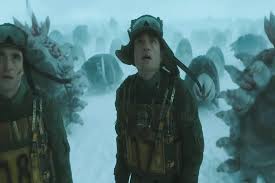
So here we are, telling you that we’re both ethical vegans – meaning it may not come as a surprise to you that one of the first things we spoke about in our post-viewing debrief was how Creepers were portrayed in the screenplay. Visually they’re quite hard to describe – which probably isn’t an accident, given they are the alien inhabitants of an ice-planet some four years travel from Earth. But imagine, if you can, something along the lines of a cross between a woodlouse and a tardigrade. They move kind of like a seal, and are covered in a thick, long fur, with tentacles around their mouths. And if that sounds bizarre, visual effects supervisor Dan Glass is on record as saying they needed to feel both “horrific and terrifying.”[i]
The term “Creepers” is coined by Kenneth Marshall, an egotistical failed politician leading the mission to Nilfheim – more on him later. We first come across the Creepers in the opening scene, when Mickey regains consciousness after having fallen down an ice-crevice. Mickey sees a small group of them at the opposite end of the fissure, and they eventually rush towards him. Mickey thinks they’re going to eat him, but they don’t – they instead collectively carry him out of the fissure to safety. This is something Mickey only realises was deliberate from the Creepers much later in the film, by which point they have been identified by Marshall as enemies that must be exterminated for the success of the colony. They have also been identified by Marshall’s wife Ylfa as a delicacy, and a running sub-plot through the movie is her quest to use the creature’s tails in order to create the perfect dining table condiment.
Yet what is at best an instrumentalisation of the Creepers, and at worst outright hostility to their continued existence on the part of the mission’s leaders, is not echoed by the rest of the crew – something we are very aware of as the viewer. When the Marshalls kill one baby Creeper and kidnap another, prompting other Creepers to surround the ship and threaten the mission unless their infant is returned, this generates a huge amount of empathy from security agent Nasha. She sees the clear familial bonds and relationality on display between Creepers as a reason to view them as possessing moral worth. They are capable of kinship not only between themselves as Creepers, but also with the humans – as we see from them saving Mickey’s life, and their interactions at the end of the movie.
This relationality is also on display when the mission scientists realise that the Creepers are not making indeterminate noises, but are communicating with each other. A translation device is created to enable inter-species communication, and the realisation that Creepers are complex beings capable of communicating emotions and desires changes the scientists’ perception of them. The crew all come around to recognising the attitudes of the mission leaders are wrong – and so do we. And on a more prosaic level, when other characters are confronted with Ylfa’s condiment they seem horrified by the conspicuous consumption and harm that this plot line portrays. We as viewers drew parallels with the wasteful and excessive consumption of animal products in our own society.
In the interview with Variety we referenced earlier, Dan Glass said that the Creepers were deliberately designed to cause us to pause and reflect on their moral worth – to get us thinking about “how you come into a planet thinking that those [are] aliens and actually the reverse is true because it’s their planet.” You can probably tell from our lengthy exploration of the issues that we think he definitely succeeded in his aim. We even wondered, given the name was applied to them by the Marshalls, what the Creepers might call themselves – had anybody bothered to ask.
Colonies
This connects to the second prominent issue: the ethics of space colonisation. Nilfheim is already inhabited, and while they aren’t humanoid, the Creepers are the indigenous species of the planet. Enter Kenneth Marshall, the cruel, smarmy politician intent on colonising Nilfheim for his own purposes after a failed political career on Earth. Marshall is a caricature of a dictator, with enough of a loyal cult following to fill the expedition ship. With their red baseball caps reminiscent of “Make America Great Again” hats, Marshall’s mannerisms, and the show he hosts aboard the ship, he can easily be read as an allegory for US President Donald Trump – but Bong Joon-Ho has said that he took inspiration for the character not from a mix of politicians and dictators throughout the world and throughout history.[ii] Still, Marshall is backed by a conservative religious order that seeks to create a new “pure” society – and we felt this language of purity evoked the racialised reproductive orders present both in historical European colonialism and modern American evangelicalism. The movie satirises these white nationalist ideals and draws our attention to their sexual politics; for example, Marshall discourages sexual activity during the trip but encourages the voyagers to reproduce when they reach Nilfheim in order to populate the new colony. When he invites a white female security officer named Kai to dinner and comments on her reproductive potential, she responds by bluntly asking him “Am I just a uterus to you?” Despite Marshall’s protestations that he supports women’s rights, his reproductive policies would have been unlikely to back that up.
This version of the colony thankfully doesn’t come to fruition, and the expedition instead settles on Nilfheim under democratic leadership with a blossoming friendship with the Creepers. We are left with the idea that this is a peaceful and more ethical society than the one the mission left behind on Earth, and certainly more so than the one Marshall planned. Yet humans have still colonised the Creepers’ planet – and despite their ability to communicate, it’s not clear whether the Creepers ever consented to this. Difficult questions – such as what happens when the human population grows, when human activity spreads across the planet, and how this will affect the planet’s indigenous population – are left unanswered. Do the Creepers have rights? Is their way of life protected? Do they have a say in how the human colony uses their land? There’s no longer the threat of Marshalls’ overt violence against the Creepers, but given that the conditions of settler colonialism in our world are still thought of as violence, has this been reproduced on Nilfheim?
Clones
The third prominent issue is that of Mickey’s identity as a clone. The moral worth of clones or human-like androids is a common trope in science fiction, but what sets this movie apart from others is that Mickey’s memories are restored every time he is re-printed. The memories uploaded run right up to the point of his previous death rather than his joining the mission, raising the question of whether Mickey is the same continuing person throughout, or whether each Mickey is their own distinct person. We see this play out on screen when Mickey 17, who was thought to have died in the ice fissure, thus prompting the creation of a new clone, returns to the ship to be confronted by his new self – Mickey 18. Where Mickey 17 is docile, Mickey 18 is more aggressive – so the two don’t seem like the same person at first. But are they the same person, or different? Which one is the “real Mickey”? And why does this matter at all, if we see each Mickey as being of their own individual moral worth? Mickey’s girlfriend Nasha doesn’t see a meaningful difference between them. She maintains an intimate relationship with Mickey through every version, including with Mickeys 17 and 18 simultaneously. She sees these not as distinct relationships, but as the same continuing relationship with the same person throughout these many iterations. In this she seems to be an outlier though, as in the society portrayed in the movie, the ‘Multiples Dilemma’ sees neither version of Mickey as a person of moral worth – when one copy is living at the same time as another, the penalty is death for every version.
This is an interesting point to come to, because on the ship we are left uncertain as to how much moral worth the crew sees each individual version of Mickey as having. Perhaps this is due to a deeper issue with Mickey’s job, and the fact that very idea of the “expendable” as somebody whose job role shows that they are literally disposable; for example, when we are shown the deaths of previous Mickeys, we see their bodies being thrown into the same incinerator as the rest of the colony’s waste. The fact that the role of “expendable” and the cloning procedure it depends on is banned on Earth – and eventually on Nilfheim too – shows that, deep down, the crew of the mission know that something is very wrong with what is being done. But few characters acknowledge this. The fact that scientists do not treat Mickey with respect – a point demonstrated by us seeing them forget to place a table by the cloning machine to take his new body, causing it to flop comically onto the floor on multiple occasions – suggests they don’t see Mickey as a person of full moral worth in the same way as they see each other. Similarly, when Mickey 17 falls down the ice fissure, Timo – his friend from back on Earth – retrieves his equipment but leaves him for dead, because he can just be reprinted again. Mickey is a commodity; his body is treated like it’s the property of the colony, to be used, terminated, and reprinted as often as they like. This is itself an interesting commentary on the role, moral worth and replaceability of the worker in modern capitalism in our own society. We wondered whether the fact that the new society on Nilfheim has confronted the problem of expendable workers might shape its approach to the socio-economic rights of its entire workforce going forward.
A few days after our visit to the cinema, we noticed that critics’ reviews were mixed. Reading what had been published, we wondered whether we’d seen the same film. We think that Mickey 17 does a great job of exploring a range of complicated philosophical issues an accessible way, and it does so in a way that doesn’t feel like you’re sitting through a lecture. And through all this, it still manages to entertain. A rare and extremely difficult feat, and we’d really recommend you take the time to see it if you get the chance.
Dr Joshua Jowitt is a Senior Lecturer at Newcastle Law School in the UK. He is a legal theorist specialising in contemporary secular natural law theory, which holds that a rule’s moral permissibility is a necessary condition of its legal validity, and his recent monograph was awarded the European Award for Legal Theory in 2022. His recent work has applied this methodology to questions of moral and legal personality, and he has worked on this question during visiting research positions at the Library of Congress, the Max Planck Institute for Comparative Public and International Law and the Cambridge Centre for Animal Rights Law. Josh has also done extensive public engagement activity, and has had work published in the Blackwell Philosophy and Pop Culture series.
Dr Zoe Tongue (she/they) is a Lecturer in Law at the University of Leeds in the UK. She works in feminist legal theory in the context of international human rights law, particularly around reproductive rights, healthcare and bioethics, and animal rights. Their PhD thesis explored a feminist approach to abortion as a moral right, holding that this ought to be recognised in the international framework. Zoe’s more recent research has focused on law and reproductive rights as portrayed in speculative fiction. Her essays on feminist issues in science fiction and fantasy have been published in Strange Horizons and Ancillary Review of Books, and they have had work published in the Blackwell Philosophy and Pop Culture series.
[i] Abigail Lee, “‘Mickey 17’ creepers were inspired by sea lions and squid to feel believable” Variety 17 March 2025 at https://variety.com/2025/artisans/news/mickey-17-vfx-supervisor-dan-glass-1236339051/.
[ii] Jessica Wang, “Bong Joon Ho says Mark Ruffalo’s Mickey 17 villain isn’t a Trump parody’ Entertainment 5 March 2025 at https://ew.com/bong-joon-ho-donald-trump-inspired-mark-ruffalo-mickey-17-villain-11688849


 The Blackwell Philosophy and Pop Culture Series