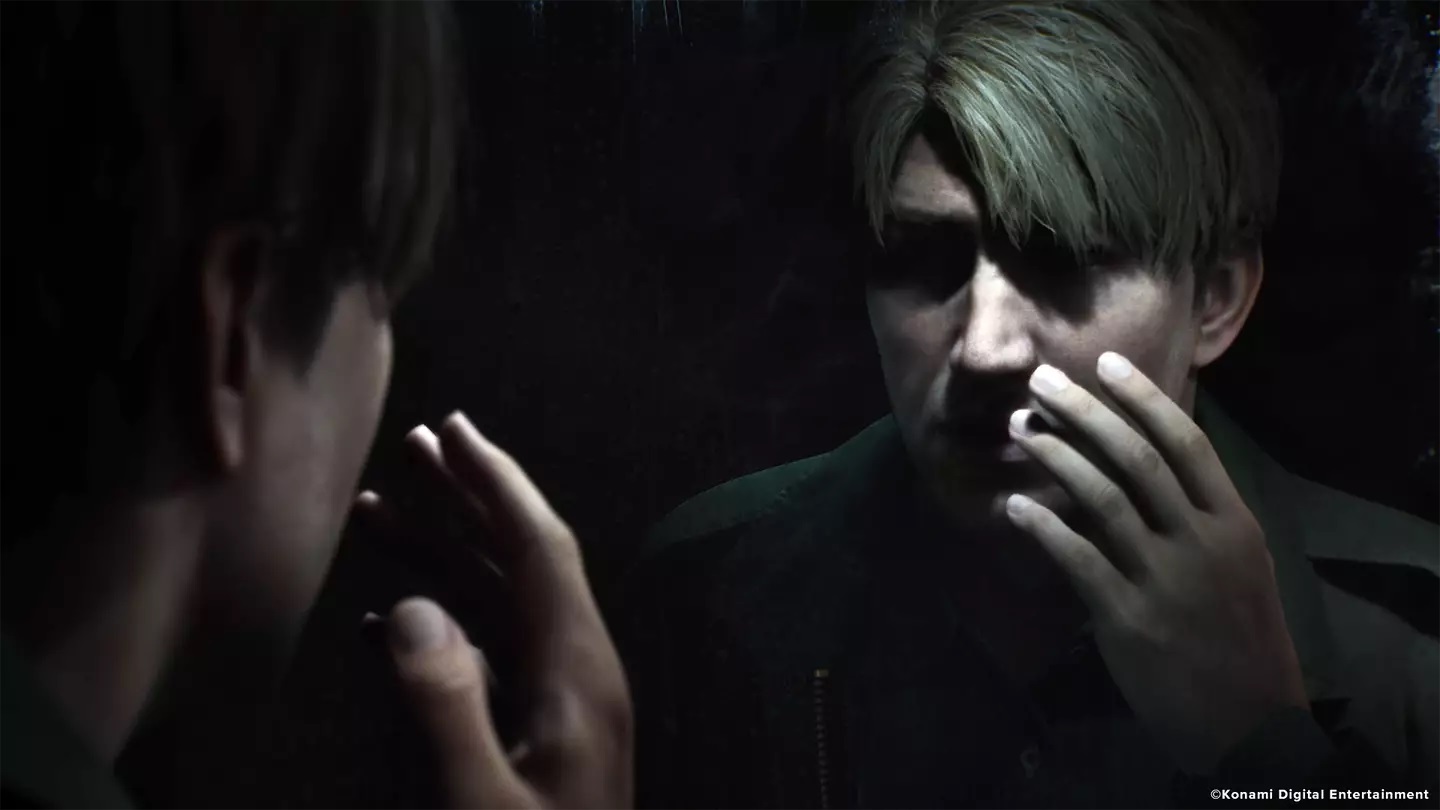
Suicide and Redemption:
James Sunderland’s Quest for Meaning in Life in the Streets of Silent Hill 2
Franlu Vulliermet
Silent Hill 2 tells the story of James Sunderland, who returns to Silent Hill after receiving a letter from his dead wife, Mary, telling him she is awaiting him there in “their special place.” Following James, torn between disbelief and the hope of finding his wife, the player explores the misty, monster-filled streets searching for Mary. Despite the straightforward story, the game is highly metaphorical, and the exploration of the strange city is also an exploration of James’ tormented psyche. While the player and James progressively uncover the truth, many elements are left unexplained and open to interpretations, which has fueled many fanbase discussions.
More than a quest searching for a lost lover, SH2 raises questions related to death, child abuse, guilt, grief, and despair. The game progressively unravels these themes with hints during the playthrough, such as equivocal notes that motivate some players to go through the story several times to discover and understand elements they missed the first time. Most importantly, three possible endings vary depending on the player’s actions, and each ending casts the story in a different light.
SH2 plunges the player into the dark regions of the human mind. As we’ll see, first and foremost, the game is about despair and a quest for meaning in life. To grasp this interpretation, we’ll view the game through the lens of The Myth of Sisyphus by Albert Camus.
For our interpretation, we’ll consider despair in a more metaphysical sense, not as a sentiment per se and not linked to the probability of having one’s desires fulfilled. Instead, metaphysical despair is the vertigo of existence, grappling with the indisputable fact of the human condition confronting its finitude. While Camus does not explicitly refer to despair, he advances in The Myth of Sisyphus the idea that answering whether life is worthwhile is the fundamental question of philosophy. According to Camus, not only does the world not have a transcendental meaning for humans, but it does not have any deeper or higher meaning at all. Nevertheless, humans look for such a meaning essentially because they are aware of the finitude of their condition. The absurd emerges through the confrontation between this human appeal and the silence of the world that does not answer. When one only sees an impasse in this situation, a form of despair emerges to which only extreme solutions such as suicide or murder would seem possible. The absurd entails that life has no value in itself, although humans long to have one. Because they are aware of their finitude, they want their life to be worthwhile. Coming to this realization plunges humans into despair.
The town of Silent Hill evokes the absurd. Wrapped in a mysterious mist, the streets are empty (except for monsters), some blocked by unexplainable huge scaffoldings or bottomless chasms. Furthermore, the few people James meets, such as Eddie and Angela, seem as lost as he is. Angela is a young woman looking for her (apparently) living mother in a graveyard, and Eddie is a young man showing psychopathic behaviors who is on the run for unclear reasons. At each encounter, they speak in confused words, and it seems they do not “make sense” at all, leaving the player puzzled and disoriented. Throughout the game, it becomes clear that all of them are confronted with their mortal human condition and suffering in a specific way.
More strikingly, a second look at James’s attitude reveals that he might actually be looking for meaning more than that he is looking for his wife, Mary. At the beginning of the game, James meets Angela in the graveyard, and she warns him that there is something strange about the town. However, with little consideration for her words, he walks away. As the game progresses, the town becomes increasingly threatening, populated with more and more monsters. When James meets a terrified Eddie gagging in the toilets, he advises him to leave the town, recognizing it is dangerous out there. Yet, James is not scared, although he is far from equipped to deal with monsters. Unlike Resident Evil, another popular survival horror game where the characters who face monsters are trained military members and police officers, James is the ordinary man in the street. This aspect is fully integrated into the gameplay. James is not very agile and fights mostly with an iron pipe throughout the game, giving the players the sensation that they are fighting for their lives. So, why does James keep going? Love, one could say, but that is not it, or it is only half of the story. SH2 is not like a traditional game where the goal is to save a princess, and the player feels the quest is coming to an end by defeating stronger and stronger enemies. SH2 plunges the players into an atmosphere suffused in despair, leaving them wandering, trying to figure out what happened in the city and what these human-like avatars populating it are. When Pyramid Head, an invincible creature and James’s nemesis, appears to track him down, SH2 becomes a struggle for life—finding Mary becomes backgrounded even during the respite of the exploratory phases. Yet, if even after several encounters with Pyramid Head, James is not scared to die, it is because it is not only his lover he is looking for, but his reason for living, which Mary embodied.
It may seem petty to say that Mary is James’s reason for living in the face of an absurd world where life does not have any transcendental or higher meaning. However, Camus does not discard the idea that a relative meaning would be possible. Life can have a meaning for me, which might make it worthwhile despite the absurdity of it. Camus gives the example of Don Juan, who does not seek eternal love or a higher purpose but instead finds meaning in the immediate pleasure of seducing many women. If James has realized the absurdity of life and the world, it does not preclude him from having a relative meaning. In Silent Hill, Mary, and her love embody the relative meaning he seeks.
In The Myth of Sisyphus Camus describes a murdering climate and a suffocating sky. This feels very much like walking through the town of Silent Hill, always covered in mist or under dark, heavy rain. The town’s creatures look like broken humans, afflicted with strange diseases and seem to be in pain themselves. Silent Hill is a world where the absurd becomes real, dragging people into despair and suffering as they confront it. Until the truth finally comes out, James delves into the abyss, both literally and figuratively. He will only face increasing absurdity and more suffering. Absurdity shreds humans in their inner being to the point of making them “sick” and invites them to die.
The three possible endings represent the three possible stances humans can take when facing the absurd. According to Camus, the unbearable suffering and lack of inherent meaning push some to commit suicide. In the In Water ending, James, unable to cope with his grief and guilt, drives his car into the lake, thus killing himself. We could simply interpret this as guilt, grief, or suffering from failing to rescue Mary. However, it is more a loss of meaning that pushes James to commit suicide. The second stance is what Camus calls a “philosophical suicide.” Some try to escape the absurd through a transcendent sense, such as God or an absolute Truth. For Camus, this stance is a form of renouncement; it is the denial of the absurdity of the world. In the Maria ending, James walks out of Silent Hill with Maria, a young woman he met during the game. It is as if he had found a relative meaning to live through Maria instead of Mary. Except that Maria does not really exist. She is a fantasized version of Mary, and James has come to this realization after watching her being killed and revived to be killed again. Thus, in this ending, he is in denial and escapes absurdity with an illusory relative meaning. Finally, revolt is the last and only acceptable stance in facing the absurd according to Camus. One lucidly accepts the absurd without attempting to escape it. Then, such a person can live a full life by accepting the absurd without trying to escape it, without metaphysical hope, yet embracing freedom and passion in the present. In the Leave ending, James faces his trauma and actions and leaves Silent Hill with Laura. While his fate is unknown, he does not try to escape the absurd anymore.
James’s story reminds us what it means to be a human being. The awareness of our finitude pushes us to find meaning in life. When the crushing realization comes that there is no meaning, absurdity hits us, and we are plunged into despair and suffering. It is up to each one of us to find out how to answer to it, in death, denial, or acceptance.
Franlu Vulliermet is a doctoral researcher working on a normative account of environmental relationships in the context of pollution and epigenetics. His research engages with a variety of schools of thought including Non-Western perspectives from South America. He has special interest in relational ontologies and Japanese Philosophy.


 The Blackwell Philosophy and Pop Culture Series
Interesting exploration of human Fate and man’s quest for meaning. Rightly pointing to “common stories” as a way out, and to “Love”.
I think Camus and Franly underestimate the structural meaning offered by parental love: love and concrete, tangible, warm care offered to the human being in the thousand first days of it’s existence: in Sub Sahara Africa, there is as good as no suicide problem. I connect this to the very present, warm and devoted “Mama Africa”.
As a historian, I was struck to find almost not a single one image in the iconography of the middel ages of a mother carrying her infant or baby on the back or the breast; whereas in Asia and Africa, photo’s of mothers doing just that, while active in front of the hut or in the rice fields are plenty.
Is the West adrift (e.g. in increasing apprehension towards politicians and science, and in the novel fact of ten year old children presenting themselves at SPOED with plans for suicide!) because of a lack of motherly care to the baby and the infant that is going on since centuries, and is only increasing due to “emancipation” of the woman?