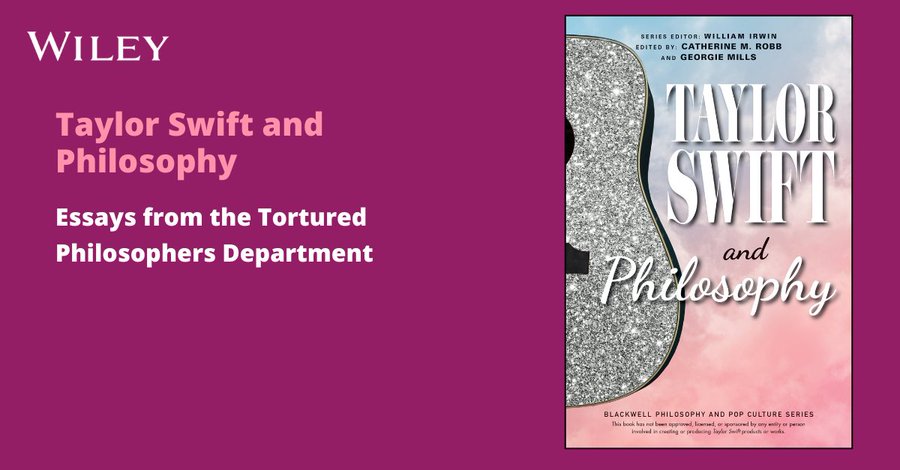
The essay below appears originally as Chapter 1 in Taylor Swift and Philosophy.
Is Taylor Swift a Philosopher?
Catherine M. Robb
After being awarded an honorary doctorate by New York University (NYU) in 2022, Taylor Swift gave a commencement speech for the graduates. During her speech Taylor spoke of the exciting challenge of figuring out who we are and who we want to be: “we are so many things, all the time. And I know it can be really overwhelming figuring out who to be, and when.”[i] Taylor tells us that we all play different roles, and our identity is not defined by just one of them. Taylor, for example, is not only a singer and songwriter, but also a film director, actress, celebrity, honorary academic doctor, and the self-appointed Chair of the “Tortured Poets Department.”[ii]
Many cultural commentators have added the role of “philosopher” to the list that defines Taylor. The journalists Kayla Bartsch, Peter M. Juul, and Clare McCarthy have all claimed or reported that Taylor is a philosopher.[iii] Scott Hershovitz, a philosopher and writer for The New York Times, has claimed that Taylor is a philosopher of “forgiveness,”[iv] and others have stated that Taylor has a philosophy of “writing,”[v] “dating,”[vi] and “music.”[vii]
Although Taylor has spoken openly about many aspects of her life, as far as we know she has never called herself or identified as a philosopher. Taylor’s music, career, and life as a celebrity is philosophically interesting, raising philosophical questions that are worthy of further discussion and exploration. But it is a much stronger claim to say that Taylor is, herself, a philosopher. So, how can we decide if Taylor really is a philosopher?
The Answer is Not That Simple
You might think that the answer to this question is easy—all we need to do is figure out what being a philosopher is or what philosophers do, and then see if Taylor fits this description. So, how do we define what it is to be a philosopher? It seems obvious that philosophers do philosophy, and so if Taylor is doing philosophy then she is a philosopher, and if not, then she’s not a philosopher—simple, right? Well, as you’ve probably guessed given the number of pages left in this chapter, finding a definition of what philosophy is and what philosophers do is not that simple. Philosophers disagree about this so much that some even think it is impossible or useless to define what philosophy is.[viii] There are good reasons for this difficulty.
First, philosophy is difficult to define because it is pluralistic—hard to pin down as being about just one thing. It is possible to study the philosophy of almost anything, including many of the themes that Taylor explores in her lyrics, such as friendship, love, heartbreak, gender, reputation, and knowledge. The way that we can do philosophy is also highly varied. Some philosophers will approach a particular topic, like heartbreak, by focusing on how it is experienced from a first-person point of view, and others will try to define heartbreak as accurately and consistently as possible. Still, other philosophers might do philosophy by considering the role that heartbreak plays in our well-being and interactions with others, and some might analyze how heartbreak is felt differently depending on one’s gender. All these methods count as philosophy.
It is so difficult to pin philosophy down as being about just one thing or method because making decisions about the right way to do philosophy is itself a philosophical issue.[ix] After all, we can do philosophy of anything—even of philosophy itself. Because philosophers have different theories, ideas, and arguments about what philosophy is, answers to the question, “What is Philosophy?” are hotly debated and controversial. If it is just a part of philosophy that we cannot agree about what it is, then how can we figure out whether Taylor is a philosopher?
Life Hacks and Embracing Cringe
One way to get out of this stalemate is to forget that professional philosophers argue about what philosophy is, and just use the everyday understanding of philosophy that most people agree on. One popular assumption about philosophy is that it consists in words of wisdom, guiding principles and values that provide advice about how to live and what to do.[x] If you’ve ever given anyone general life advice— “never go to sleep angry” or “never trust someone who lets you down twice” —then on this definition you are a philosopher.
This way of understanding what philosophy is certainly makes Taylor Swift a philosopher. All of her albums include song lyrics scattered with pieces of wisdom and guiding principles for how to live and what to do. Beginning with her debut album, Taylor gives us wisdom about how to deal with an uncertain future (“A Place in This World”), and advice against cheating on your partner and asking for forgiveness retrospectively (“Should’ve Said No”). Fast forward 16 years to the release of Midnights, and Taylor continues to impart philosophical wisdom. In “Vigilante Shit” she gives advice about the best way to take revenge, and in “Mastermind” she explains the role of women as a “pawn in every lover’s game.”
Taylor has also expressed her philosophical views in interviews and speeches. In her 2023 TIME Person of the Year interview, Swift supplies wisdom on how to deal with our enemies, recommends that we take time to celebrate ourselves in the present, and reminds us that “Life is short.”[xi] In her 2022 NYU commencement speech, Taylor shares a number of “life hacks” that she hopes will be helpful to us “navigating life, love, pressure, choices, shame, hope and friendship.”[xii] If we take a “life hack” to be the same as a piece of wisdom about how to live a good life, then we can see Taylor as offering us quite a few pieces of philosophical wisdom. She tells us that we ought to embrace cringe, embrace the mistakes that we’ve made because these often lead to the best things in our lives, and leaves us with a message of resilience and empowerment: “hard things will happen to us. We will recover. We will learn from it. We will grow more resilient because of it.” One of my favorite guiding principles that Taylor has shared came after the Superbowl game in 2024, when she told Travis Kelce that “jet lag is a choice.”[xiii]
And so, if philosophy is defined as being able to articulate and live by guiding principles and pieces of wisdom, offering life hacks and suggestions for how to live a good life, then Taylor is definitely a philosopher. This is also what some journalists and media reports have in mind when they claim that Taylor is a philosopher, because her lyrics contain “words of wisdom” and “valuable life lessons,”[xiv] because she reminds us “of the things that truly matter in life,”[xv] and “offers genuine insight.”[xvi]
Unsolicited Advice
There is a problem with labeling Taylor as a philosopher in this way, though. If philosophy just means sharing words of wisdom, then not only is Taylor a philosopher but so is almost everyone else. I’m sure we’ve all been at the receiving end of unsolicited advice given to us by friends and family, co-workers, taxi drivers, people standing in line next to us at the store or coffee-house, or even people sitting next to us on public transport. All these people too would have to count as philosophers. This just seems implausible—as the contemporary philosopher Edward Craig has claimed, understanding philosophy in this way means it is “so broad as to be close to meaningless.”[xvii] There must be something more that Taylor does if she is a philosopher.
Philosophy has to do with how we critically reflect on and scrutinize our beliefs, figuring out whether they stand the test of time. As philosopher Julian Baggini writes, doing philosophy is not blindly accepting a piece of wisdom, but involves a “systematic investigation of the nature of the world”—this entails providing reasons for our ideas and beliefs that can be “scrutinized, judged, assessed, accepted or rejected.”[xviii] It is not enough to just state your life hack; you must also provide a systematic or methodical way of critically reflecting on that life hack, considering more carefully how you arrived at your belief, and providing reasons to support your view. Taylor has given us many different life hacks throughout the years, but does she critically reflect and methodically scrutinize these life hacks, giving us reasons for why we ought to believe them?
Simple Existential Questions
Contemporary philosophers have already begun to do this critical reflection on Taylor’s behalf, taking her views on topics she’s written about in her lyrics, and highlighting how these touch on already-existing philosophical ideas and questions. For example, Keshav Singh has shown how Taylor’s lyrics about the relationship between love and madness track the different theories of historical philosophers such as Nietzsche (1844-1900) and Plato (c. 427-347 BCE).[xix] Luke Russell highlights the philosophical assumptions that Taylor makes about forgiveness, clarifying these ideas and asking us further questions to reflect on.[xx] And Lindsay Brainard has offered a philosophical analysis of “Champagne Problems” as a way to think more critically about the ethics of making good decisions.[xxi]
In these examples the philosophers are the ones doing the heavy lifting when it comes to the critical reflection and scrutiny of the ideas that Taylor expresses in her lyrics. This only goes to show that Swift is being philosophical—offering up ideas, thoughts, and questions that have the potential to be philosophically analyzed by “real” philosophers. Maybe this isn’t such a problem. Taylor herself acknowledges that some of her lyrics are philosophical. When describing the chorus of “Lover” she says, “I wanted the chorus to be these really simply existential questions that we ask ourselves when we’re in love.” Here, Taylor expresses the philosophical idea that being in love alters our identity and sense of who we are. Stating this idea is certainly philosophical. But on the definition of philosophy we’ve been exploring, to be a philosopher Swift would need to critically reflect on and provide a methodical analysis of the reasons for believing the idea. But who is to say that Taylor does not critically reflect on the pieces of wisdom and philosophical questions she raises in her lyrics, interviews, and speeches?
A Narrow Operation
The philosopher Iris Murdoch (1919-1999) claimed that because philosophy involves “the critical analysis of beliefs,” it must be “discursive” (providing reasons and justification for the claims that you make), “direct” (clearly and explicitly getting to the point), and “abstract” (only dealing with general theories and ideas rather than particular personal experiences).[xxii] And as the contemporary philosopher Susan L. Anderson has summarized, according to the standard idea of philosophical method, we do philosophy when we express our “views as clearly as possible, in an unemotional fashion, defending them with arguments, defining crucial terms, and considering all possible objections to one’s view.”[xxiii] This would mean that only a limited selection of texts would count as philosophy, usually only written by those who are trained in university philosophy departments and publish in professional philosophy journals. Songs definitely would not count.
However, this concept of philosophy is too narrow and restrictive. Many famous philosophers were not philosophy professors or even students in philosophy departments, such as René Descartes (1596-1650) who studied law and mathematics, and David Hume (1711-1776) who studied Latin and Greek. And many well-respected works of philosophy take other forms than a direct and abstract piece of writing—for example Plato’s famous dialogues, Mary Wollstonecraft’s (1797-1851) letters, or the way in which African philosophers have used oral traditions to pass down their work without the use of a written text at all. As the philosopher Edward Craig argues, to think that philosophy is a “narrow operation that only occurs in universities” is “restrictive and misleading.”[xxiv] Philosophical analysis can take different forms depending on the culture and historical time period, and it is more than just an abstract written text authored by a philosophy professor at a university. So, in what way do Taylor’s songs, speeches, and other works count as philosophy?
Double Standards and Personal Experience
Taylor actually does critically analyze her life hacks, words of wisdom, and ideas. How? By reflecting on her own personal experiences and that of fictional characters. As an example, let’s take Taylor’s analysis of gender stereotypes and discrimination. In her acceptance speech as the first ever recipient of Billboard’s Woman of the Decade award in 2019, Taylor tells us that “people love to explain away a woman’s success.”[xxv] On its own, this would be a mere nugget of wisdom. But in that same speech, Taylor offers many different personal examples that support her statement: people claimed that her record label, male producer, or male co-writer were the reason for her success, and people accused her of lying about writing her own songs. Ultimately, Swift observed, she was held to higher standards than male artists. In an interview for CBS News in 2019, Taylor gives further support for her claim that women are subjected to double standards: “A man does something, it’s strategic. A woman does the same thing, it’s calculated. A man is allowed to react. A woman can only overreact.”[xxvi]
Throughout her discography, Taylor systematically examines the different aspects and experiences of the discrimination experienced by women—from the perspective of one’s emotions not being taken seriously (“mad woman”), double standards (“The Man”), being cast as a homewrecker (in the folklore love triangle), the difficult tension between being in a steady relationship and pursuing one’s own career (“Midnight Rain”), and the social pressure to have a reputation of being a “good girl” (“Bejeweled”).
Looking at Taylor’s body of work as a whole, we see that her method is to state standard stereotypes that women are subjected to, and at the same time consider how and why they ought to be subverted. For example, in “mad woman” she highlights the typical stereotype that “no one likes a mad woman,” in “Vigilante Shit” it is the fact that “Ladies” are always expected to play nice and “always rise above,” and in “Lavander Haze,” Taylor writes of the idea that women are either thought of as “a one-night” stand or a “wife,” with there being no middle-ground. Yet at the same time, Taylor sings of how these stereotypes ought to be challenged: “If a man talks shit, then I owe him nothing” (“I Did Something Bad”); “I’m so sick of running as fast I can / wondering if I’d get there quicker / if I was a man” (“The Man”); “I’m damned if I do give a damn what people say / No deal, the 1950s shit they want from me” (“Lavander Haze”).
Rather than offering an abstract written discussion exploring the reasons for challenging each stereotype, Taylor provides an account of what it is like to experience these double standards, from either a personal point of view or from the point of view of an imagined character as part of a fictional narrative. In “The Man,” Taylor wonders what it would feel like for her if she was not subjected to the double standards thrown at her, and in “Miss Americana and the Heartbreak Prince” she sings about what it feels like for her to be labelled a “bad, bad girl.” But in “the last great american dynasty” Taylor sings of Rebakah’s experiences of being labelled as a mad, chaotic, and sad woman, and in “august” she sings of Augustine’s experiences of being cast as the “other woman.”
As Taylor explains during her Billboard acceptance speech, her albums are an account of how she attempts to subvert the sexist labels put on her: “Whatever they decided I couldn’t do is exactly what I did. Whatever they criticized about me became material for musical satires or inspirational anthems.”[xxvii] What makes this approach powerful is that it does not analyze the sexist stereotypes from an abstract and detached point of view. The harm that these stereotypes can have on women is real and experienced as part of everyday life. The way women challenge these stereotypes is not theoretical, but performed by acting in ways that subvert expectations and questioning the status quo. This is messy, and not something that can always be abstractly and directly explained without emotional weight.
The value of Taylor’s contribution to feminist philosophy is the way she uses her own personal experiences and fictional characters to explore, challenge, and subvert negative gender stereotypes that have caused harmful discrimination against woman. In doing so, Taylor doesn’t merely state a life hack or piece of wisdom. Instead, she critically reflects on and critiques gender stereotypes, systematically.
The Accidental Philosopher
“But, Taylor Swift writes songs,” the skeptic might proclaim, “how can this be philosophy?” Taylor isn’t doing philosophy in any of the standard ways that we would teach philosophy students when they take a philosophy course in high school or university. But if doing philosophy involves critically reflecting and systematically analyzing our worldviews and beliefs, then Taylor is doing that by offering a first-personal and fictional analysis in her songs, interviews, and speeches.
The contemporary philosopher Martha Nussbaum claims that poetry, fiction, and storytelling can be powerful tools for philosophers to express certain philosophical truths about how to live a good life. Nussbaum argues that when Western philosophy first emerged in Ancient Greece, it was the poets who were the “central ethical teachers and thinkers” because their works allowed for a “process of inquiry, reflection.”[xxviii] This makes sense because philosophical inquiry often requires “the perception of particular people and situations rather than abstract rules.”[xxix] And so, doing philosophy is not just about providing an abstract theory that has nothing to do with emotions or our own personal lives. Instead, Nussbaum implies that we can also be philosophers by providing stories of our own personal experiences, or the experiences of fictional characters and circumstances, using these to methodically reflect and analyze our beliefs and ideas about how to navigate the challenges of living a good life. And this is the way that Taylor Swift is a philosopher.
Of course, even if we think Swift is a philosopher, it doesn’t mean that all her work counts as philosophy, or that she is a philosopher all the time. And we don’t know whether Taylor ever intended to be a philosopher—maybe it’s a label that she doesn’t even want. But being a philosopher is something that Taylor should be proud of, using her work to systematically reflect on the big questions in life. There are good and bad ways to do philosophy. After all, philosophers train for years to sharpen their thinking skills and analyze systems of thought and different forms of argumentation. Without this training, Taylor is an accidental philosopher. But just think of the philosophical wisdom that will leave us enchanted when her philosophical skills “polish up real nice.”
[i] Hannah Dailey, “Taylor Swift’s NYU Commencement Speech: Read the Full Transcript,” Billboard, May 18, 2022, at https://www.billboard.com/music/music-news/taylor-swift-nyu-commencement-speech-full-transcript-1235072824/.
[ii] Taylor Swift, “All’s fair in love and poetry…” Instagram, February 5, 2024, at https://www.instagram.com/p/C28vsIzO_bL/?utm_source=ig_web_copy_link&igsh=MzRlODBiNWFlZA==.
[iii] Kayla Bartsch, “Taylor Swift: Empress of the Zeitgeist,” National Review, September 24, 2023, at https://www.nationalreview.com/2023/09/taylor-swift-empress-of-the-zeitgeist/; Peter M. Juul, “Reflections on Taylor Swift, or the pop Star as Philosopher,” Peter M. Juul: Writer, Researcher, Policy Analyst, December 31, 2019, at https://pmjuul.com/2019/12/31/reflections-on-taylor-swift-or-the-pop-star-as-philosopher/; Clare McCarthy, “Taylor Swift the great philosopher: Headteacher says she should be viewed alongside Shakespeare and he uses her lyrics for inspiration in school assemblies,” Daily Mail, April 10, 2021, at https://www.dailymail.co.uk/news/article-9455857/Headteacher-praises-Taylor-Swift-great-philosopher-quotes-lyrics-school-assemblies.html.
[iv] Scott Hershovitz, “Taylor Swift, Philosopher of Forgiveness,” New York Times, September 7, 2019, at https://www.nytimes.com/2019/09/07/opinion/sunday/taylor-swift-lover.html?action=click&module=Opinion&pgtype=Homepage.
[v] Marcus Chan, “Taylor Swift and Ed Sheeran’s Writing Philosophies,” Medium, October 31, 2021, at https://writingcooperative.com/taylor-swift-and-ed-sheerans-writing-philosophies-905305ac1574.
[vi] Zach Seemayer, “Taylor Swift Gets Personal About Friends & Romances: ‘I Don’t Make the Same Mistake Twice,’” ET, August 3, 2015, at https://www.etonline.com/music/169265_taylor_swift_gets_personal_about_friends_romances_i_don_t_make_the_same_mistake_twice.
[vii] Jocelyn Vena, “You Will Never Believe Who Taylor Swift Just Called Her ‘Friend,’” Billboard, 24 April, 2105, at https://www.billboard.com/music/music-news/taylor-swift-glamour-uk-interview-6545767/.
[viii] Edward Craig, Philosophy: A Very Short Introduction, (Oxford: Oxford University Press, 2002), 5; Stephen J. E. Norrie, “What is Philosophy? Prolegomena to a Sociological Metaphilosophy,” Metaphilosophy 49 (2018), 649.
[ix] Graham Priest, “What is Philosophy?” Philosophy 81 (2006), 189; Søren Overgaard, Paul Gilbert, and Stephen Burwood, An Introduction to Metaphilosophy (Cambridge: Cambridge University Press, 2013), 3.
[x] Overgaard et al. (2013), 2.
[xi] Sam Lansky, “2023 Person of the Year: Taylor Swift,” TIME, December 6, 2023, at https://time.com/6342806/person-of-the-year-2023-taylor-swift/.
[xii] Hannah Dailey (2022).
[xiii] Hilary Hanson, “Taylor Swift’s 5-Word Take On Jet Lag Will Have You Go, ‘Hmmm,’” Huffington Post, February 17, 2024, at https://www.huffpost.com/entry/taylor-swift-jet-lag_n_65d0d71de4b0f7fbe7b2d130.
[xiv] McCarthy (2021).
[xv] Juul (2019).
[xvi] Hershovitz (2019).
[xvii] Craig (2002), 8.
[xviii] Julian Baggini, How the World Thinks: A Global History of Philosophy (London: Granta Publications, 2018), xxx.
[xix] Keshav Singh, “Swift on Love and Madness,” Daily Nous, April 7, 2023, at https://dailynous.com/2023/04/07/philosophers-on-taylor-swift/#singh.
[xx] Luke Russell, Taylor Swift is Never Ever Going to Forgive You,” Daily Nous, April 7, 2023, at https://dailynous.com/2023/04/07/philosophers-on-taylor-swift/#russell.
[xxi] Lindsay Brainard, “Can Gut Feelings Solve ‘Champagne Problems’?” Daily Nous, April 7, 2023, at https://dailynous.com/2023/04/07/philosophers-on-taylor-swift/#brainard.
[xxii] Iris Murdoch, “Philosophy and Literature,” in Brian Magee ed., Men of Ideas (Oxford: Oxford University Press, 1982), 233-236.
[xxiii] Susan L. Anderson, “Philosophy and Fiction,” Metaphilosophy, 23 (1992), 204.
[xxiv] Craig (2002), 9.
[xxv] Rebecca Schiller, “Taylor Swift Accepts Woman of the Decade Award at Billboard’s Women In Music: Read Her Full Speech,” Billboard, December 13, 2019, at https://www.billboard.com/music/awards/taylor-swift-woman-of-the-decade-speech-billboard-women-in-music-8546156/.
[xxvi] David Morgan, “Taylor Swift: ‘There’s a different vocabulary for men and women in the music industry,’” CBS News, August 25, 2019, at https://www.cbsnews.com/news/taylor-swift-preview-sexist-labels-in-the-music-industry/?ftag=CNM-00-10aab6i&linkId=72505330&fbclid=IwAR0Tu6eR1hHvOgN7gbB10UfIAfOJHfucfWpI5BF7ZVpzcsb-khuCOIe_L9A.
[xxvii] Schiller (2019).
[xxviii] Martha Nussbaum, Love’s Knowledge: Essays on Philosophy and Literature (New York: Oxford University Press, 1990), 22.
[xxix] Nussbaum (1990), ix.


 The Blackwell Philosophy and Pop Culture Series