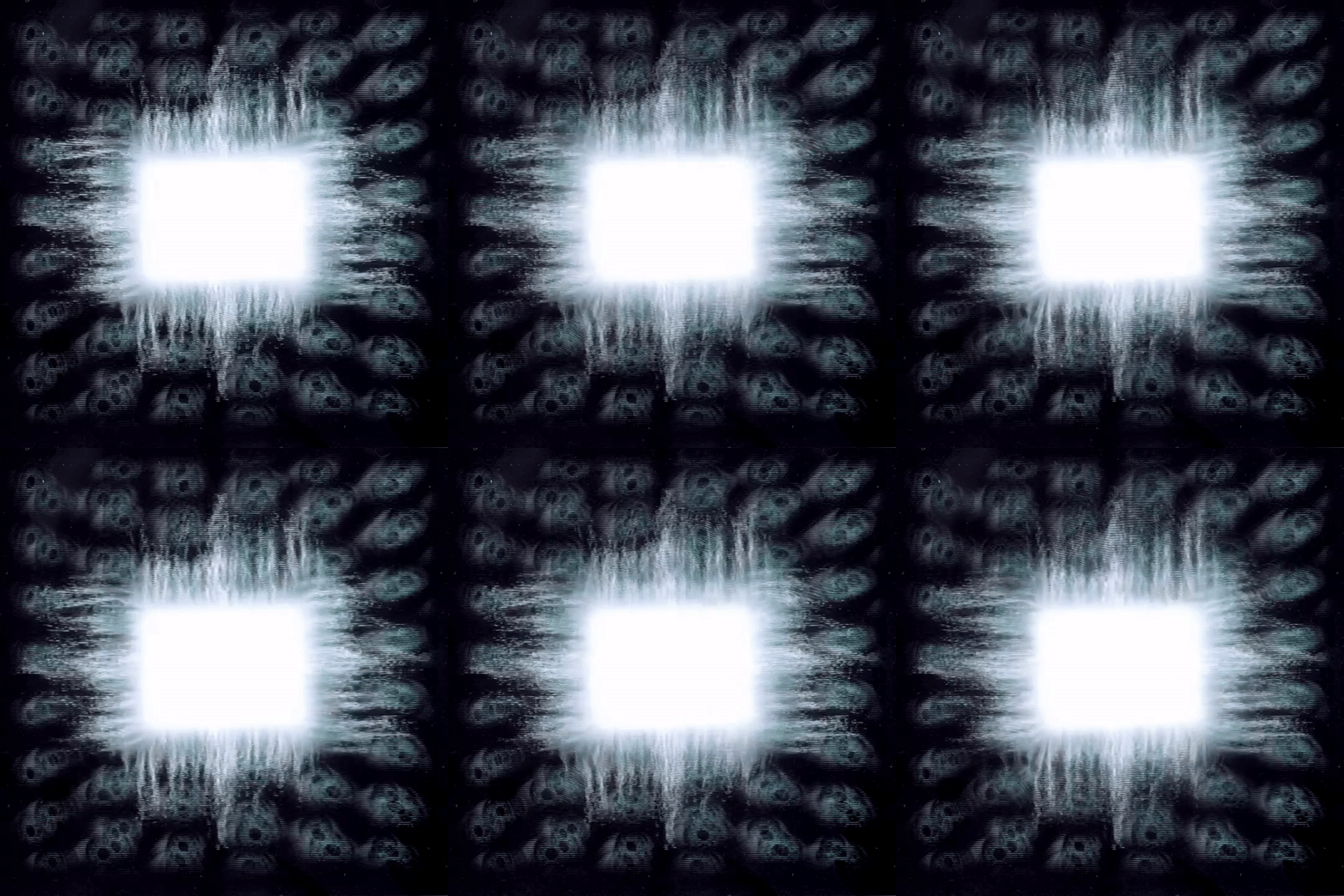
I’ve Missed You So Much
Tool and the Jungian Shadow
Kevin Morris
A young boy is on a large body of water at night in a small rickety vessel. When you helped him launch earlier in the day, it was calm and serene. Now the wind is strong, the water is rough and chaotic, tossing the vessel to and fro. The cloud cover is complete and there is no light. The boy is terrified and disoriented. He cannot rest; he can only fight the wind and waves through an endless night. He wonders why you have rejected him, abandoned him on the black open water. You know his fear and exhaustion, why don’t you help? He doesn’t like you, he bites, but what do you expect? Deep down, he’s missed you so much, and just wants the weather to change.
Tool released Ænima, their second full studio album, in 1996. While several tracks have an accessible structure, and are very well-suited for crowd sing-alongs, the album marks the band’s transition to more experimental heavy music. Ænima explores themes related to personal change and growth, clearing out what is unnecessary and harmful and learning to live and thrive with that which is necessary and cannot be set aside; the subsequent 2001 Lateralus explores the results of these prior adventures in sonic psychotherapy. Ænima is gritty, raw, and exhausting. Some of the tracks are no-nonsense emotional piledrivers (“H.,” “Jimmy,” “Pushit”); others are basically jokes (“Hooker with a Penis,” “Message to Harry Manback,” “Die Eier von Satan”); some straddle the line (“Stinkfist,” “Aenima”). Several explore quasi-intellectualish-sounding themes (“Eulogy,” “46 & 2,” “Third Eye”). In a 2026 Pitchfork retrospective on Aenima, Jeremy Larson mused:
I wonder if rock music that tries to be smart is actually dumber than rock music that knows it’s dumb, and should not be critiqued as a failed attempt at entering into the realm of smart music. Is half-way smart all-the-way dumb? […] After all these years, I don’t think Ænima is serious, but it is in perfect harmony with itself. It is the setup and the punchline. It is the perfect joke.
I think Larson is basically right, but it occurs to me that a perfect joke can be serious and straight-faced, delivered without remorse.
Some things can be cleared out–while we cannot change the past, we can change our attitude towards the past; we can excise blame, hate, this or that grudge, swaths of negativity that no longer serve us. If someone in our life is truly malignant, we can sometimes as a last resort physically remove the tumor, putting it into a quiet corner in hopes that it might one day become benign so that we might rediscover communication. However, excision is not always possible, and in these cases, our only hope is to learn to live with our psychological neighbors and to make the best of challenging but inevitable situations. This is how the Swiss psychologist Carl Jung (1875-1961) understood what he termed “the Shadow.” According to Jung, each person has a Shadow, a part of us that includes myriad fears, insecurities, and traits like anger, selfishness, and greed that we hide from public view, and often from ourselves. Jung thought that we cannot be rid of our Shadow, that it is a kind of inherent feature (“archetype”) of human psychology. According to Jung, failure to recognize our Shadow–our fears, weaknesses, and perceived defects–results in inner conflict, a war within our own psyche, leading to all manner of difficulties in our public lives, from writer’s block to everyday irritability to violent outbursts wildly incommensurate with their causes. However, Jung also believed that by recognizing and appreciating our Shadow, we can live more harmoniously with ourselves and others, and can even release creative impulses within us that have been repressed as part of rejecting our Shadow. The Shadow can be visualized as a human being; just picture yourself at your most vulnerable, surrounded by spiteful enemies. When abandoned and left to drift on open waters, the Shadow misbehaves, throwing all manner of fits and tantrums. Your Shadow may at first look wretched and exhausted, and your attempts to bring it ashore may be met with gnashing teeth. It takes work, but over time your Shadow will appreciate your attention; nobody, not you, not your Shadow, wants to live in endless fear of their neighbor.
Written and performed by Maynard James Keenan, Tool’s lyrics are thematic if elusive, sometimes reflective, veering into high-brow jargon, sometimes crude. Some songs exhibit a story-like progression, as “Stinkfist” spins a tale that begins with a finger, then sequentially involves a knuckle, elbow, and ultimately shoulder (the logical analysis of “Stinkfist” will wait for a later occasion). Jungian themes are most prominent on Ænima; the title combines Jung’s expression for the feminine part of male psychology (“anima”) and an English expression the meaning of which we should know. While it would be pointless to attempt to describe Maynard’s lyrical intentions, several songs are naturally understood as exploring Jung’s concept of the Shadow–the challenges in recognizing and approaching this side of us, the hurt that can be involved in making amends with this entity, the powerful consequences that can result from reconciliation. While as a teenaged dilettante I knew of Jungian elements in Ænima, I did not engage with Jung’s ideas until later encountering them in the work of psychotherapist Barry Michels. I discovered Michels through his work with the guitar virtuoso Buckethead. Michels is the coauthor of the best-selling book and therapeutic vision named–you won’t believe this–The Tools. If that’s not synchronicity, I don’t know what is.
The Jungian Shadow is most commonly associated in the Tool fan collective unconscious with “46 & 2,” the fifth track on Ænima, the one with the best bassline. “46 & 2” combines metaphors–a mythical being that has reached a higher state of multi-dimensional consciousness through gaining an extra pair of chromosomes;[1] a snake-like image of “shedding skin” and “crawling on my belly,” which comports perfectly with said bassline; and repeated references to “my Shadow,” which has served as the basis for crowd singalongs for the past 30 years. While you might think of your Shadow in many ways–for example, as a skinny boy adrift at night–one approach is to conceptualize your Shadow as a shadow. This seems to be what is going on in “46 & 2.” The Shadow is described as “old” and “numb,” “shedding skin”; Maynard begs about wanting to know what he’s been hiding in “my Shadow,” and the song ends with the Shadow “stretching up and over me,” with the protagonist “coming out the other side” with “forty six and two just ahead of me.” Through conceptualizing the Shadow as a shadow, we might attempt to “step into” it, so that we might “grow, take and give,” “move, learn and love,” “like, kill and give,” and “die, learn and love.” We can “soften this old armor” and accept the things that we hide, but are part of who we are. As we all discovered as children, there are difficulties in ever truly stepping into your Shadow-qua-shadow (or shadow-qua-Shadow?), given physical laws governing rectilinear propagation and angles of incidence; it is, as it were, always one step ahead. When 20,000+ Tool fans, now including many middle-aged men, yell in unison about “my Shadow,” it is doubtful that any of them acquire additional chromosomes, or gain direct conscious access to the 12th dimension, but with some luck, maybe a few get on better with their loved ones.
“Jimmy” is the ninth track of Ænima, and the first of several songs over his now-long career in which Maynard reflects on his mother Judith Marie, who suffered a stroke when he was 11 years old and was paralyzed for the remainder of her life, passing away in 2003.[2] Whereas “46 & 2” represents the Shadow as a shadow and is explicitly Jungian in orientation, we might understand Maynard’s reflections on himself as a child–“Jimmy”–as engaging in Shadow work, with the child as the Shadow. Near the start, we hear that “eleven is standing still, waiting for me to free him by coming home,” and “has been and will be waiting,” suggesting that Jimmy has been left alone, lonely among “the dead and hopeless” after “she was gone” and “we waved goodbye.” Among the things that we hide in the Shadow are our vulnerabilities, the heartbreaks we don’t want anyone to see. “Under a dead Ohio sky,” Jimmy wonders “where the hell have I been,” at which point Maynard remarks that “I’m so glad that I have found you, I am wide awake and heading home,” and pleads for his younger self–“I wish that I could see turn and run to play”–to “carry my ancient soul… into the light.” He asks that Jimmy might “hold your light where I can see it, hold it high,” with the hopes that through a reunion they might “move on together” “as soon as pain allows.” We might envision our Shadow tossed to and fro, but we might also imagine it frozen catatonic; and in ignoring our Shadow, we are stuck as well. The Shadow wants to be seen, and holds its lantern high, if only we have the courage to search through the night. Maybe we can’t go home, and we can’t change the past, but we might learn to be more trusting, and maybe get past that writer’s block.
“Pushit” is the tenth track on Ænima, and according to pundits, has something to do with abuse, as suggested by the refrain “you’re pushing and shoving me, pushing and shoving me, pushing and shoving me,” and the concluding verse in which, with “survival as my only friend” “I claw your fucking throat away, it will end no other way.” Well, let’s take a calming breath and ask who or what is involved in this situation. We might think it of it as a confrontation with the Shadow gone wrong–you go to see your Shadow, thinking it will be a day in the park, and it snarls and bites; but what choice to do you have? You can’t move on without it. Near the start, we find:
Know that I will choke until I swallow
Choke this infant here before me
What is this but my reflection?
Who am I to judge or strike you down?
We might visualize the Shadow as an infant, but the infant can be dangerous, without warning growing to an amorphous beast in our dreams, and while it is pointless to try to tame this beast or reason with this infant, we can find “just a little peace of mind” if we are willing to put in the work and show compassion for this side of ourselves. This is not easy, we may end up in a place we “don’t want to be” and that we “never want to see” again, and maybe in some cases our best bet is to take a step back and regroup. Tool has developed different live versions of “Pushit,” one with a very patient introduction; on all of these versions, however, Maynard’s delivery is haunting and utterly desperate. That’s how it goes when engaging with your Shadow.
“Third Eye” is the concluding track, and is perhaps best known for the introductory soundbite from Bill Hicks touting the wonders of psychedelic drugs; it is a sprawling epic, with twists and turns, rises and falls, clocking in at over 13 minutes. When I used to be on Twitter, I once joked about how “Third Eye” should be played loud at restorative yoga; it got 9 likes and 2 retweets. Tool’s “Third Eye” sharply contrasts with Third Eye Blind, the pop-rock band that rose to fame not long after Ænima was released, and while you might achieve a semi-charmed kind of life with a blinded third eye, it’s fair to set your sights higher, and Bill Hicks certainly wasn’t talking about the semi-charmed kind of drugs. Let’s move on.
If we are going to pry open our third eye, the organ that lets us see past appearances and into our inner being, what do we see? A purple orangutang with an elephant’s trunk riding a motorcycle? Maybe you see your Shadow, “a child’s rhyme” stuck in your head, “singing one familiar song”:
So good to see you
I’ve missed you so much
So glad it’s over
I’ve missed you so much
When we seek our Shadow, it may hide, despite craving attention, as a hungry feral cat may dart from one bush to another as we approach, and similar to “Jimmy,” Maynard continues:
Came out to watch you play
Why are you running away?
Came out to watch you play
Why are you running?
When I listen to these lyrics, I think of a play of perspectives, back and forth from the protagonist to their Shadow, each wondering why the other has neglected them; they are having a conversation by echoing each other’s contributions. We might think that our Shadow is hiding, and our Shadow might think that we have run away, “chasing the tail of a dogma,” “a trail of smoke and reason.” But the fact of the matter is that we’ve missed each other so much. “Third Eye” is plausibly understood as describing a psychedelic trip, but it is a trip into the concrete reality of our own selves, that part of us that we need but often avoid and neglect.
Jung emphasized that in engaging with our Shadow, we should not expect to ever free ourselves of inner conflict and turmoil, this is nothing less than the human condition. However, we can take different attitudes towards this part of ourselves, towards the reality of conflict, turmoil, and ultimately suffering; there are of course similar themes in all known religious traditions. Throughout songs like n “46 & 2,” “Jimmy,” “Pushit,” and “Third Eye,” we find this dynamic interplay within ourselves; as in Jung, we find the idea of embracing these conflicts as our condition, and that only in doing so can we find some manner of harmony within ourselves, and in the world around us.
Kevin Morris is an associate professor of philosophy at Tulane, where he teaches and writes about metaphysics, philosophy of mind, and the history of analytic philosophy. He first saw Tool live on the 2001-2002 tour, with last-minute seats in Trenton, NJ hanging right over the stage, and hopes that the Tool army won’t be too harsh in judging his first foray into Tool-inspired propaganda.
References
Larson, Jeremy. 2006. Ænima, Tool. Pitchfork. Online: https://pitchfork.com/reviews/albums/tool-aenima/. Accessed on August 1, 2026.
[1] As suggested by New Age spiritual thinker Drunvalo Melchizedek. Maynard attended a week-long seminar with Melchizedek in 1995; see Larson 2026 for discussion.
[2] Others include the pair “Wings for Marie” and “10,000 Days” on the 2006 Tool album 10,000 Days and “Judith” on the 2000 Perfect Circle album Mer de Noms.


