The essay below originally appears as Chapter 10 of The Legend of Zelda and Philosophy, edited by Luke Cuddy.
Solving the Puzzle of Cheating:
Honor and Integrity in Hyrule
Charles Joshua Horn
One of the earliest examples of a “cheat” code in the Zelda series occurs in the first video game released in 1987 for the Nintendo Entertainment System (NES). At the very beginning of the game, when you name your character, if you input “ZELDA,” you will bypass the first playthrough of the game and immediately start the Second Quest. The Second Quest (sometimes relabeled through the series as “Master Quest” in later games) has been a staple in several Zelda games throughout the franchise. Second Quest is a completely different way to play the game which utilizes a different Map layout, more difficult enemies, and even items that are in different locations. You can “cheat” and get straight to the reward.
In an interview with Polygon, the director of Breath of the Wild and Tears of the Kingdom, Hidemaro Fujibayashi remarked that “to be blunt and honest, cheating can be fun.”[1] In the interview, Fujibayashi explained how the “Ascend” ability in Tears of the Kingdom was the result of a debug feature in the game that designers thought wouldbe enjoyable for the players. The producer of these video games and longtime Zelda architect, Eiji Aonuma, also labeled the basic powers of the game as ways to cheat. He remarked, “coming up with these cheat code-style abilities (Ascend, Ultrahand, Fuse, and Recall), it did create some issues for us.”[2] These issues were about how to marry natural progression and freedom in the game with the ability to “break” it for the purposes of enjoyment.
The comments by Fujibayashi and Aonuma raise an interesting question. The question isn’t whether gamers should cheat, but instead what does it mean to cheat, especially in single-player video games like those in the Zelda series. Like all great questions, this one is debatable. So, let’s see what philosophers and gamers say before we answer it for ourselves.
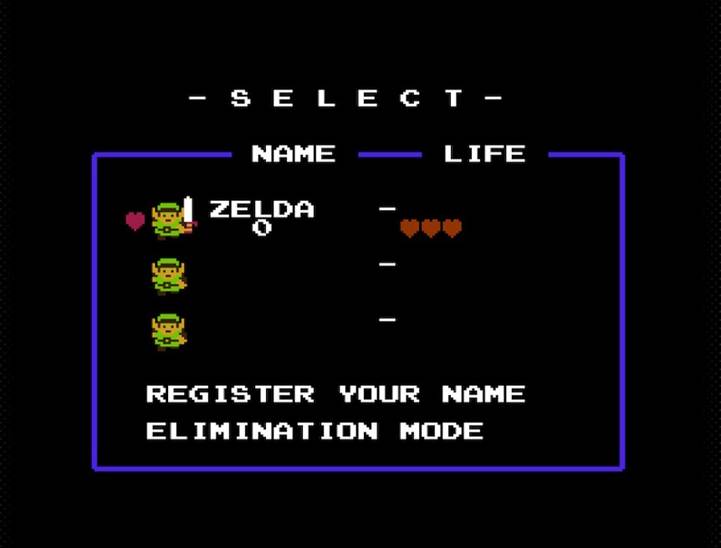
Inputting “ZELDA” in the original game allows players to bypass the first playthrough and go straight to the Second Quest (The Legend of Zelda, Nintendo Entertainment System, 1987).
Cheating as Violation of a Rule
The most obvious account of cheating is that it’s a violation of a rule. Some philosophers argue that cheating is a violation of the rules of the game, and others suggest that cheating is a violation of the rules between the players. Contemporary philosopher, A.J. Krieder, for instance, argues that cheating is about violating rules between the participants in the game. He writes, “cheating is the breaking of a covenant with the other players. If there is no covenant, then there is no playing—but then there can be no cheating either.”[3] In the Philosophy of Sport, one common example in discussions of cheating is the use of performance enhancing drugs (PEDs) by athletes, since their use violates the rules of many sports—rules put in place to maintain a level playing field between competitors.
Unfortunately, video games are not like sports with clearly defined rules. The “rules” are almost always hidden to the gamer in the form of code created by the programmers. While it’s a very common practice with PC modifications to video games nowadays, there have been ways to change the code even in the earliest Zelda games. One of the earliest, easiest ways to act contrary to the code to violate a rule and “cheat” was by using Game Genie. The Game Genie was a cheat cartridge that players could insert their video game into in order to play it in a way not intended by the creators. When players booted up their video game using a Game Genie, they were given the ability to input a “code” to manipulate the code of the game. The Game Genie codes in the original The Legend of Zelda offered perks like invincibility, more Heart Containers, infinite Bombs, and unlimited rupees. There’s no need for the Triforce of Courage when Link can’t get hurt!
Although conceiving of cheating as a violation of a rule is intuitive, many philosophers reject this account on the grounds that rules don’t seem to be exhaustive of ways to cheat. If an act violates a rule, then it may be true that it’s cheating. But it isn’t true that if an action is cheating, then it’s a violation of a rule. One statement doesn’t entail the other. Put simply, rule violation just isn’t broad enough to capture everything that we want. After all, there are many instances in games where players’ actions can violate a rule, but we would not call it cheating. Penalties in sports are violations of rules that aren’t cheating, for example.
Because the rules of video games are most often captured in code, an example of a game within a video game might be most useful to illustrate that understanding cheating as rule violation is inadequate. One of my favorite clever “cheats” is in Ocarina of Time. When playing as Child Link, he can enter the Back Alley entrance of Hyrule Market and play the Treasure Chest game. This game presents Link with two Treasure Chests in a room and the player must choose which Chest to open. The correct Chest includes a Key to the next room and the wrong Chest includes rupees. In order to move to the next room, Link must select the Chest with the Key. If you select the correct Chest five times in a row, then the final room contains a Heart Piece. You can keep trying and hope to get lucky (which is presumably how the shop keeper expects to make rupees since the odds are very low), or Link can use the Lens of Truth, an item found in the well in Kakariko Village, and see the contents of each Chest before opening them.
There isn’t a rule in the shop notto use outside sources and even if there were, there probably wouldn’t be a specific rule prohibiting the use of the Lens of Truth. When Link uses the Lens of Truth to identify the contents of the Chests, he isn’t breaking a rule. And yet, there is a strong intuition that Link is cheating by acting in a deceptive way. Some people think that it’s deception and not the violation of the rule that constitutes cheating. The historian, J. Barton Bowyer (1931-2003), for instance, defines cheating as an intrinsically social activity which includes an element of deception. He writes, “to cheat, not to play the game that reflected the norm, indicated that there was another world, the world of deception, in which people did not play the game, your game, but their own.”[4]
Cheating as Breaking the “Magic Circle”
Beyond thinking of cheating as a rule violation, another way to conceptualize cheating occurs when the gamer breaks the “magic circle.” The magic circle is a term drawn from the work of historian, Johan Huizinga (1872-1945), and used to denote the boundaries of the video game.[5] Anything within the boundaries of the video game, the magic circle, is permitted. And anything beyond the magic circle is not permitted and considered cheating. On this model, cheating may involve using Nintendo Power for help, consulting your friends at school, or even using notebook paper to draw Maps and take notes when playing the original The Legend of Zelda (surely, I’m not the only one!).
One very common way that players engage with difficult games, including those in the Zelda series, is to seek help from resources outside of the video game itself. Gamers will regularly consult resources like guides for help in solving confusing puzzles, beating difficult bosses, or knowing the steps to complete a hidden questline. After beating the Water Temple in Ocarina of Time dozens of times, it’s still easy to get lost or forget a Key. Guides are also handy for knowing the steps to some of those long side quests in Majora’s Mask which require everything to be completed at specific times and days (like the memorable quest to reunite Anju and Kafei). The guidance of the Sages pales in comparison to the Nintendo Power Line from the late 1980s!
Sometimes the help from outside the video game doesn’t come in the form of knowledge, but in the accumulation of items to help inside the video game. Since 2014, Nintendo has marketed and sold a series of toys called “amiibo” which can be used in conjunction with their video games. Players can scan the toys and cards into Breath of the Wild to receive rewards like weapons, Shields, costumes, and rupees. For Breath of the Wild, Nintendo didn’t think that obtaining items through resources outside of the game constituted cheating. Nintendo had a different position regarding item duplication in Tears of the Kingdom. During the first few days after the game was released, gamers found a way to duplicate items using a glitch in the code. Nintendo promptly released a patch for the video game which eliminated the duplication glitch.[6] In the minds of the developers at Nintendo, it appears as if duplicating items was acceptable so long as you paid for the privilege by purchasing amiibo. Ironically, Princess Zelda uses a duplication spell as one of her primary powers in Echoes of Wisdom. This strongly suggests that, at least from the perspective of the developers at Nintendo, there is nothing intrinsically wrong with duplicating an item in Zelda series.
Ultimately, the concept of the magic circle is not much help in delineating what constitutes cheating. After all, gamers disagree about the boundaries of the magic circle, a point Mia Consalvo makes well. She writes, “At some point, players must make individual decisions about what they will and won’t read, who to ask and for how much information, and so on, in playing a game.”[7] But this is just tantamount to saying that gamers should decide for themselves what cheating is. And while gamers have competing accounts of what it means to cheat, it doesn’t follow that every account is correct.
Cheating as a Violation of the Game’s Purpose
Another way to conceptualize cheating is to think of it as an activity that allows the gamer to play in a way that is contrary to the purpose of the game. It’s interesting that this account of cheating is represented least in the philosophical literature, but it arguably encompasses the most common way to cheat throughout the Zelda series, an unsurprising consequence given the vast amount of freedom granted to the player. As the following examples make clear, gamers have found creative ways to play in ways unintended by the developers at Nintendo and which seemingly run contrary to the purpose of the game.
One of the more famous ways to “cheat” in the Zelda series is in the classic, A Link to the Past. Utilizing a glitch in the code, there is a relatively famous way to beat the game in under five minutes by completely bypassing the room with the final boss, Ganon. The player jumps off a ledge in the main room of Hyrule Castle, quits to the main menu in midair, and then walks into a particular wall without getting hit by an enemy until the last second. If this is completed correctly, Link will drop through the floor and can walk right past Ganon’s lair to obtain the Triforce. Who said the hero’s journey needed to be difficult? Unlike many glitches in the speedrun community, this strategy is easy to accomplish, so the reader should try it.
Another example to illustrate how cheating might be thought of as playing in a way unintended by the game creators and designers can be found in Breath of the Wild. Speed runners found a way to propel Link vast distances by doing an advanced skill called “bullet time bounce.” The player Shield-surfs off a high ledge onto an enemy, then uses the Bow in midair to enter “bullet time.” Link is propelled through the air at such great speeds that Hyrule’s landscape has a difficult time loading on the Nintendo Switch hardware. Clearly, this was not intended by developers.
The primary way to upgrade Heart Pieces and stamina in Breath of the Wild is to complete shrines scattered all over the Map. These shrines include various sorts of challenges that typically require the gamer to solve a puzzle or defeat an enemy. Some of these puzzles utilize the motion sensor and gyroscope in the Switch controller to move a part of the puzzle. In a difficult and frustrating puzzle utilizing these controls in the Myahm Agana Shrine, players must tilt the controller to move the entire maze so that a ball moves through it. Gamers discovered after shedding many tears in the Kingdom that if you turn the controller upside down, the entire maze flips upside down so that the ball doesn’t need to navigate the maze at all; the player can just kick the ball up to the pedestal and complete the shrine. Aonuma reflected on this very shrine in an interview to help explain the design philosophy of Echoes of Wisdom. He stated, “It’s like finding a secret trick in the game, just like the old days… If this kind of solution isn’t allowed, then it’s not fun. We talked about how the player can kind of ‘cheat’ in many places. I’m always really happy when I manage to solve something in an unexpected way, doing something where I’m not sure if it’s even OK to do it like that. I guess it ties in with the idea of ‘being mischievous’.”[8] There are far too many ways to complete these shrines to suggest that the developers at Nintendo intended and planned every single way for gamers to beat them. Moreover, Aonuma points out that structuring the Zelda games in a way where players do the unexpected is a good thing.
Part of the difficulty in what we might call a teleological account of cheating, an account related to the purpose, is that gamers might have very different intuitions regarding the purpose of a video game. Or maybe there are multiple purposes. Or perhaps the video game has a purpose, but it is impossible for anyone to figure out. Or worse still, perhaps there is no purpose to the video game at all! Here’s an example drawn from outside Hyrule to illustrate the difficulty of determining the purpose of a game. In 2001, the Supreme Court of the United States decided a case which required the Justices to debate and explain the purpose of golf. Casey Martin is a professional golfer who has a degenerative circulatory disorder that made it impossible to walk the golf courses. At this time, golf carts were not allowed on the PGA tour, and he argued that since his disorder was protected by the Disabilities Act of 1990, it was a reasonable accommodation that he be given a golf cart for the tour. Other golfers protested and argued that Martin was given an unfair advantage since the energy expended by walking the course would inevitably affect shot accuracy. While the majority of the Supreme Court agreed with Martin’s argument that the golf cart wouldn’t alter the purpose of the game (to hit a ball in a small hole from great distances), Justice Antonin Scalia dissented arguing not that the purpose of the game was altered using a golf cart, but instead that the purpose of golf could not be ascertained at all.
Justice Scalia’s criticism is made seemingly at every single moment of Tears of the Kingdom. This video game makes clear time and time again that it’s extremely difficult, if not impossible, to determine the intent of the creators. And even if the developer intent mattered, which developer does the gamer need to understand? Modern games are designed by hundreds (if not thousands) of individuals across many years, and the way the game is intended to be played may change from person to person and across the development period. In fact, the designer may not even foresee the way that the game is going to be played, so it’s reasonable that they may not intend for the game to be played one way at all! As a result, thinking of cheating in these teleological terms doesn’t work well either.
Cheating as an Unfair Advantage
The most common way that philosophers understand cheating is not in terms of rule violations, breaking the magic circle, or worrying about the creator’s intentions, but rather by thinking about it as an activity that gives the player an unfair advantage.[9] S.K. Wertz defines cheating partly in terms of unfair advantages. He argues that someone cheats if they intentionally or unintentionally acted in a way “through which the constitutive or regulative rules and conditions for winning a contest are changed in favor of one side.”[10]
In the case of games where players compete against each other, this definition makes a lot of intuitive sense. The rules of a game are usually constructed precisely not to give one player or team an unfair advantage over the other players or teams. This fact is perhaps clearest in the rules against doping in sports, which would give those taking the PEDs an unfair advantage over those players not using them. There are analogues in video games too. Speaking primarily as a console player, it’s difficult and frustrating to play multiplayer games against gamers on PC because those players have numerous ways to cheat so that they have an unfair advantage.
If cheating is thought of as having an unfair advantage over others, then it would follow that gamers can’t cheat in single-player games. After all, in a single-player game there is no one else to have an unfair advantage over. For example, it would be impossible to cheat in the single-player Ms. Pac Man in an arcade because there is no one else there to cheat. However, if the gamer is competing against others for a high score in the very same Ms. Pac Man, then cheating could occur if the player has an unfair advantage over the others aiming for the high score.
One might wonder whether someone can “cheat themselves” playing in a single-player game. After all, we sometimes use this language when we talk about cheating on a diet, for instance. Wertz suggests that “any adequate definition of cheating needs to cover specific cases of self-cheating”[11] and that a self-cheater “robs himself or herself of what the rules of the game provide: a measure of skill, superiority, esteem, pleasure, pride, self-confidence.”[12] Similarly, contemporary philosopher Sinclair MacRae argues that cheating ought to be defined as wrongful competitive norm violating where the action deprives the player of legitimate success. He argues that “Cheating is wrongful norm violating precisely because it undermines the pursuit of success on the basis of merit where such efforts are ethically defensible.”[13]
While it’s true that a good account of cheating should address self-cheating, it need not include it as a possibility. I’m inclined to think that self-cheating is impossible. To self-cheat would be to have an unfair advantage over oneself. And to have an unfair advantage over oneself would require simultaneously having at least two separate selves, which is impossible—we are unified beings. When someone cheats themselves in the way Wertz imagines, it’s better to say that we’re just playing a different game than we were before. And there’s no reason to prioritize playing the old game over the new one.
The Zelda series has been a single-player game for almost 40 years (even though the characters sometimes occur in multiplayer games like Super Smash Bros. and Mario Kart). If cheating is thought of as having an unfair advantage over another player, then it would follow that in single-player games like those found in theZelda series, cheating is simply impossible—there’s no one else to have an unfair advantage over. For example, it might be argued that we are cheating ourselves in some way by using a glitch to pull the Master Sword from the pedestal in Breath of the Wild before having the requisite 13 Heart Containers (a feat which can be accomplished at the outset of the journey!). We might insist that we would have deprived ourselves of the reward for working so diligently at obtaining those Heart Containers and having the experience of struggling through the early game with breakable weapons. But I’m inclined to think that this isn’t a case of cheating because there is no unfair advantage over another player.
Cheating, Cheesing, Exploiting, and Glitching
Ultimately, cheating is simply impossible in single-player games like Zelda. And because it is impossible, it is not ethical or unethical to do the various sorts of feats described above. So, Fujibayashi’s point from earlier is partially right. The kind of behavior he was referring to can be fun, but it isn’t cheating. The Treasure Chest game from earlier is a great example to show the complexity of thinking about cheating. Based on what has been argued here, we can say that Link is cheating in the Treasure Chest game because he has an unfair advantage, while at the same time holding that the gamer who plays as Link is not cheating.
Gamers have a remarkably complex set of intuitions and vocabulary regarding cheating in all its various forms. Perhaps there is no single account of what it means to cheat in a video game; players cheat in far too many ways. As Mia Consolvo writes, “cheating is a dynamic concept that cannot be easily defined or limited.”[14] While it’s been suggested here that to cheat is to have an unfair advantage, this may be a distinct concept from other actions like cheesing, exploiting, and glitching. We may just need the Triforce of Wisdom to piece together what it means to cheat in video games like those in the Zelda series. Like Link’s many quests across Hyrule and beyond though, the journey to understand this philosophical puzzle is only fit for the courageous.[15]
[1] Mike Mahardy, “Tears of the Kingdom devs on reinventing Zelda: ‘Cheating can be fun,’” Polygon, May 12, 2023, at https://www.polygon.com/legend-zelda-tears-kingdom/23720150/zelda-tears-of-the-kingdom-abilities-eiji-aonuma-hidemaro-fujibayashi
[2] Ibid.
[3] A.J. Kreider, “Game-Playing Without Rule-Following,” Journal of the Philosophy of Sport 38 (2011), 62.
[4] J. Barton Bowyer, Cheating: Deception in War & Magic, Games & Sports, Sex & Religion, Business & Con Games, Politics & Espionage, Art & Science (New York: St. Martin’s Press, 1982), 300-301.
[5] See Johan Huizinga, Homo Ludens: A Study of the Play Element in Culture (Boston: Beacon Press, 1950.)
[6] Of course, gamers quickly found alternative ways to duplicate items in creative and nefarious ways after the patch was released.
[7] Mia Consalvo, Cheating: Gaining Advantage in Videogames (Cambridge, Massachusetts: MIT Press, 2007), 89.
[8] “Ask the Developer Volume 13, The Legend of Zelda Echoes of Wisdom—Part 2,” Nintendo, September 23, 2024, at https://www.nintendo.com/us/whatsnew/ask-the-developer-vol-13-the-legend-of-zelda-echoes-of-wisdom-part-2/
[9] For a more developed account of the argument from unfair advantage, see Tena Thau, “Rethinking the Unfair Advantage Argument,” Journal of the Philosophy of Sport 48 (2021), 63-81.
[10] S.K. Wertz, “The Varieties of Cheating,” Journal of the Philosophy of Sport 8 (1981), 26.
[11] Wertz, 23.
[12] Wertz, 23.
[13] Sinclair A. MacRae, “Cheating as Wrongful Competitive Norm Violating,” Journal of the Philosophy of Sport 46 (2019), 346.
[14] Mia Consalvo, Cheating: Gaining Advantage in Videogames (Cambridge, Massachusetts: MIT Press, 2007), 11.
[15] I would like to thank Tyler Horn, Dona Warren, Shanny Luft, and Brad Mapes-Martins for their wonderfully fun and useful conversations about cheating in video games. A special thanks to Luke Cuddy and William Irwin for comments about an early draft of the paper.


 The Blackwell Philosophy and Pop Culture Series